
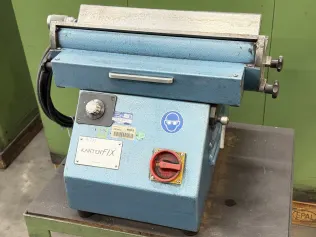
1. What Is a Deburring Machine?
A deburring machine — sometimes referred to as a trimming machine — is used to remove burrs: the small protrusions and unwanted material left on a workpiece after processing. Burrs are not always immediately visible, but they can be removed efficiently with the right equipment.
Burrs commonly occur on parts cut from sheet metal using lasers, as well as on metal stampings — though they can also appear on wooden and plastic workpieces. In a metalworking production line, the deburring process can consume significant time and resources. Modern deburring machines are faster and more efficient than earlier generations, helping manufacturers reduce costs and streamline finishing operations.
- Significant reduction in time and resources compared to manual burr removal
- Suitable for laser-cut and stamped sheet metal components
- Delivers clean, precise finishing and surface retouching
2. Types of Deburring Machines: A Complete Guide
Deburring machines come in several distinct forms, each suited to different materials, tolerances, and production environments. The most widely used approach is mechanical deburring, which uses abrasive belts and brushes to grind burrs from a workpiece, leaving a smooth, imperfection-free surface. Belt sanders are a common choice for this application, offering fast throughput across a range of metal workpieces.
Electrochemical deburring is a more advanced – and more costly – option, but it delivers a highly precise finish and integrates well into high-efficiency production lines. The process uses salt or glycol-based solutions in combination with an electrical current to dissolve burrs cleanly, often completing the cycle in as little as 10 seconds.
Thermal energy deburring is the fastest method available. The workpiece is placed inside a sealed chamber and exposed to a controlled combustible gas mixture, removing all burrs in a single stage – making it particularly effective for complex geometries with hard-to-reach surfaces.
A less common technique, rarely seen in European manufacturing, is cryogenic deburring. Liquid nitrogen is used to freeze the burrs, which are then removed by high-pressure blasting. While niche in application, it can be effective for delicate components where other methods risk surface damage.
3. Deburring & Trimming Machines: Why They Matter
Deburring with a trimming machine is an essential step in processing plastics, metal, and wood, where smooth, burr-free surfaces are a fundamental requirement. This is not purely an aesthetic concern – sharp or rough edges on sheet metal can cause serious injuries comparable to razor cuts. Before any workpiece moves further along a production line or reaches the end customer, its edges must be properly finished by a trimming machine.
Although deburring represents a relatively small part of sheet metal processing, it is one of the most critical. Deburring machines help ensure both product quality and consumer safety, making them indispensable components in most metalworking production lines. Manual deburring remains technically possible, but it introduces unnecessary costs and delays that few businesses can justify. A sheet metal deburring machine is therefore one of the most valuable investments a metalworking company can make – and opting for a used trimming machine is often a financially sound choice.
4. Used Deburring Machines for Sale – Top Brands
Used deburring machines are available to buy directly online, with stock regularly updated to include equipment from leading manufacturers such as WEBER, WÖHLER BRUSH TECH, EISENBLÄTTER, LISSMAC and HK DEBURRING. Whether you need a flat surface deburring solution or a specialist edge-finishing machine, the selection covers a wide range of metalworking requirements. If the specific model you need is not currently in stock, it is worth checking back regularly as new second-hand machinery is listed frequently.