
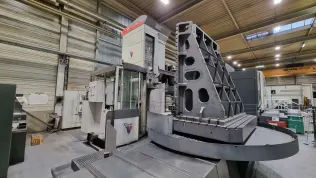
1. Horizontal Boring Mills: Uses, Features & Applications
Horizontal boring mills are versatile machine tools widely used in general mechanical engineering and machine construction. These machines are designed to perform drilling and milling operations on horizontally clamped workpieces, making them essential for producing casings, housings, and precision components.
Primary application: general machine construction and component manufacturing
Capable of holding multiple cutting tools, including drills, boring bars, milling shafts, and turning tools
Ideal for producing large casings, housings, and structural components
The spindle headstock is mounted on a movable column, allowing precise positioning and feed control. Tool holders are standardised and typically fitted with a Morse taper, ensuring compatibility across a wide range of cutting tools. Modern horizontal boring mills increasingly feature CNC technology, enabling automatic tool changes and highly efficient machining cycles.
The clamping table secures workpieces using clamping screws or equivalent fixturing systems. Thanks to their open construction, these machines can accommodate extremely large workpieces – some units stand up to 10 metres high and offer an extensive mounting surface. The robust machine bed and column together support the spindle stock, while the mounting table can be precisely adjusted across multiple axes and locked into position. CNC control, now standard on most models, ensures consistent accuracy and streamlined operation.
2. Horizontal Boring Mill: History and Development
The horizontal boring mill has a long history of development, driven by the expanding range of tasks it could perform and advances in machine tool engineering. The first boring mills were developed and manufactured in Germany in 1875, laying the foundation for the precision machinery used in industry today.
The machine tool manufacturer UNION played a significant role in shaping the modern horizontal boring mill. Today, UNION produces horizontal boring mills with drilling spindles reaching up to 250 mm in diameter, with travel along the x-axis of up to 40 m and the y-axis of up to 10 m. These machines can accommodate workpiece weights of up to 250 tonnes and feature CNC control systems supplied by leading manufacturers such as SIEMENS.
3. Horizontal Boring Mills: Applications & Industry Uses
Horizontal boring mills are a cornerstone of general machine building, serving a wide range of industrial sectors. Typical applications include the manufacture of gearbox casings and the production of precision tooling components. Their versatility makes them well suited to virtually every stage of industrial manufacturing, from roughing operations through to fine finishing work.
Precise positioning is particularly critical in the production of cutting and punching tools, where dimensional accuracy directly affects performance and longevity. Horizontal boring mills are equally valuable in mould-making, where they ensure the exact positioning and machining of guide pillars and ejector pin holes – details that are essential for consistent, high-quality results.
4. Top Horizontal Boring Mill Manufacturers
Several companies have built strong reputations in the manufacturing of horizontal boring mills. Among the most respected names in the industry are UNION, SCHARMANN, GIDDINGS & LEWIS, DAEWOO, and SACEM — each known for producing reliable, high-performance machines suited to demanding machining applications. Used horizontal boring mills from these manufacturers are widely available on the second-hand market in good working condition, offering a cost-effective route to proven engineering equipment.