
 This item is sold
 This item is sold
1. Portal Milling Machines: Design, Uses & Capabilities
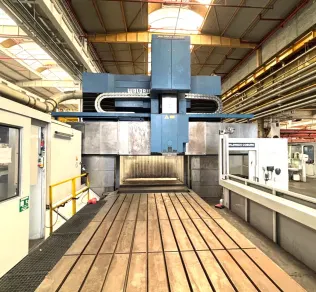
A portal milling machine is a cornerstone of industrial manufacturing, designed for the precise machining of large workpieces across a wide range of materials. Its defining feature is a crossbar of adjustable height mounted between two vertical supports – a rigid portal structure that determines the maximum workpiece width and ensures exceptional stability throughout the machining process.
Height-adjustable crossbar limits maximum workpiece dimensions, accommodating a variety of large components
Effective face milling of large surfaces in a single setup
Widely used in mechanical engineering and heavy industry
The supports can be either fixed or movable, and most designs incorporate an adjustable clamping table for greater flexibility. Two additional milling heads mounted on the supports allow all sides of a workpiece to be machined in a single clamping operation, significantly reducing setup times and improving throughput.
The inherently rigid construction of portal milling machines enables very high dimensional accuracy – down to approximately 0.005 mm – with minimal vibration during operation. This results in excellent surface finishes and consistent quality across large workpieces. The robust design also allows for high cutting capacities, making portal milling machines the preferred choice for demanding applications in machine construction and heavy industry.
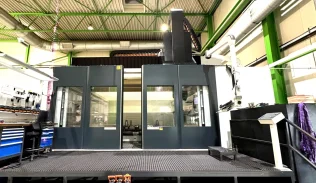
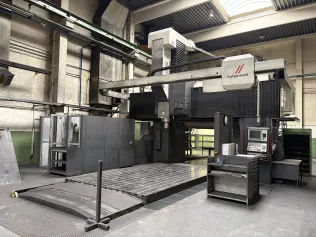
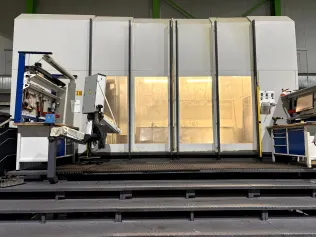
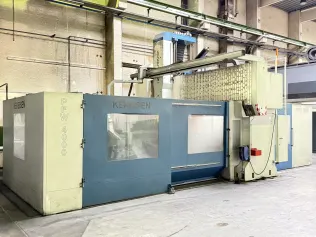
The image above shows a REICHLE & KNÖDLER portal milling machine in operation.
2. Portal Milling Machines: History and Development
Machine construction in Germany has deep roots, beginning with the founding of the first machine factory in Chemnitz in 1848, where early machine tools were designed and produced. One of the machine types to emerge from this tradition is the portal milling machine – a design that has continually evolved while retaining its core working principles.
The introduction of computer technology marked a turning point, bringing NC-controlled and later CNC-controlled portal milling machines to market. Today, the range of available machines spans compact models through to large-format systems capable of accommodating multi-ton workpieces on their machining tables.
3. Portal Milling Machines: Applications & Industry Uses
Portal milling machines are widely used in mechanical engineering and heavy industry. A typical application is the machining of cast steel and cast iron housings for transmissions, where precise face surfaces are essential to allow the housing to be flanged directly onto a motor. These machines are also well suited to heavy-duty machining of tool steel and titanium.
4. Portal Milling Machine Manufacturers & Brands
Several manufacturers have specialised in portal milling machines. Among the most reputable brands are FOREST-LINE, ZIMMERMANN, WALDRICH-COBURG, SNK, SCHIESS ASCHERSLEBEN, MAZAK, BOEHRINGER, MIKROMAT, TOS, and KOLB – each with a strong track record in producing high-quality, precision gantry milling equipment.
Used portal milling machines in good condition are widely available on the second-hand market, making it possible to acquire reliable, high-performance machinery at a fraction of the cost of new equipment.