
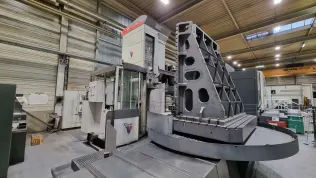
1. What Are Boring Machines?
A boring machine is a machine tool dedicated to enlarging pre-drilled or pre-cast holes, ensuring diameter, coaxiality, and concentricity within extremely tight tolerances - typically at the micron level for high-precision boring machines. It operates on the principle of a rotating spindle combined with a feed motion that cuts the internal surface of the workpiece.
Boring machines are one of the core machine groups within Metalworking Machinery, playing a key role in machine-building plants, power equipment manufacturing, shipbuilding, and aerospace.
2. Benefits of Investing in Used Boring Machines
Investing in Used Boring Machines is a priority for many mid-size and large mechanical engineering companies during capacity expansion cycles. These machines are inspected, maintained, and can run for 20-30 years when serviced regularly and the spindle is checked every 6 months.
Lower initial investment cost: A used machine typically costs only 30-60% of a new one with the same configuration (depending on brand, year of manufacture, and maintenance condition). For larger, rarer machines, savings can reach up to 70%
Fast, efficient depreciation: With a lower investment, the payback period is significantly shortened.
Stable technology, easy maintenance: Machines from leading brands such as PAMA, UNION, SCHARMANN, and TOS VARNSDORF are built with outstanding mechanical durability, and replacement parts remain readily available on the market.
Retrofit potential: Used boring machines can be fully upgraded with a new CNC control system, bringing their operating capability close to that of newer machines.
High resale value: Even after many years of operation, used boring machines from reputable brands still retain significant resale value.
3. Types of Boring Machines
Below are the main types of Boring Machines used in heavy-duty mechanical machining.
Used Table-Type Boring Machines (Table-Type HBM)
The table-type horizontal boring machine - also known as the universal type - is the most common configuration in the horizontal boring machine family. By technical definition, a table-type HBM has a fixed column and a movable table, with the following axes: table travel along Z (longitudinal) and X (transverse), spindle head along Y (vertical), plus the boring spindle/ram (W) and rotary table (B).
Thanks to this structure, Table-Type HBM machines efficiently machine large box-type parts with table loads from 3 to 50 tons, commonly used in machine building, power equipment manufacturing, and transport equipment. Leading brands include PAMA, UNION, SCHARMANN, TOS VARNSDORF, DMG MORI, and Mitsubishi Heavy Industries.
1. Advantages and Limitations of Used Table-Type HBM
Advantages | Limitations |
|
|
2. Practical Applications of Used Table-Type HBM
Machine housings and gearboxes in industrial machine building
Heavy-duty diesel engine components for marine and power generation applications
Locomotive frames and railway equipment
Compressor housings and power equipment
Used boring machines from ReMach's catalogue include the Fermat WFT 13 CNC table boring mill, built in 2017, with a HEIDENHAIN iTNC 530 control, a 40-tool changer, and travels of 3,500 x 2,500 x 1,700 mm (X/Y/Z).

Used Planer-Type Boring Machines (Planer-Type HBM)
The Planer-Type HBM (gantry-type horizontal boring machine) is built like a long table with a fixed horizontal rail above it. The workpiece travels back and forth along the table, while the spindle (holding the cutting tool) moves transversely to perform machining. For this reason, this machine type is also known as the “T-Type” horizontal boring machine. It is best suited to machining large, bulky, high-volume parts such as ship frames, turbines, and heavy equipment components
1. Advantages and Limitations of Used Planer-Type HBM
Advantages | Limitations |
|
|
2. Practical Applications of Used Planer-Type HBM
Machine bases in heavy equipment manufacturing plants
Ship hull frames and large welded structures
Columns and crane girders
Components for the wind energy industry (wind towers, gearboxes)
Used Floor-Type Boring Machines (Floor-Type HBM)
The Floor-Type HBM is a “giant machine” in mechanical machining, designed to handle parts of extreme size and weight - beyond what standard boring machines can accommodate. Instead of placing the part on a movable table, this machine type clamps the workpiece directly onto a base fixed to the workshop floor, fitted with T-slots to secure the part, while the entire spindle unit moves to perform the machining.
1. Advantages and Limitations of Used Floor-Type HBM
Advantages | Limitations |
|
|
2. Practical Applications of Used Floor-Type HBM
Hydropower turbine housings and nuclear power plant components
Large marine engine housings
High-capacity hydraulic press frames
Main shafts and machine components in the cement and mining industries
Wide-body aircraft components in the aerospace industry
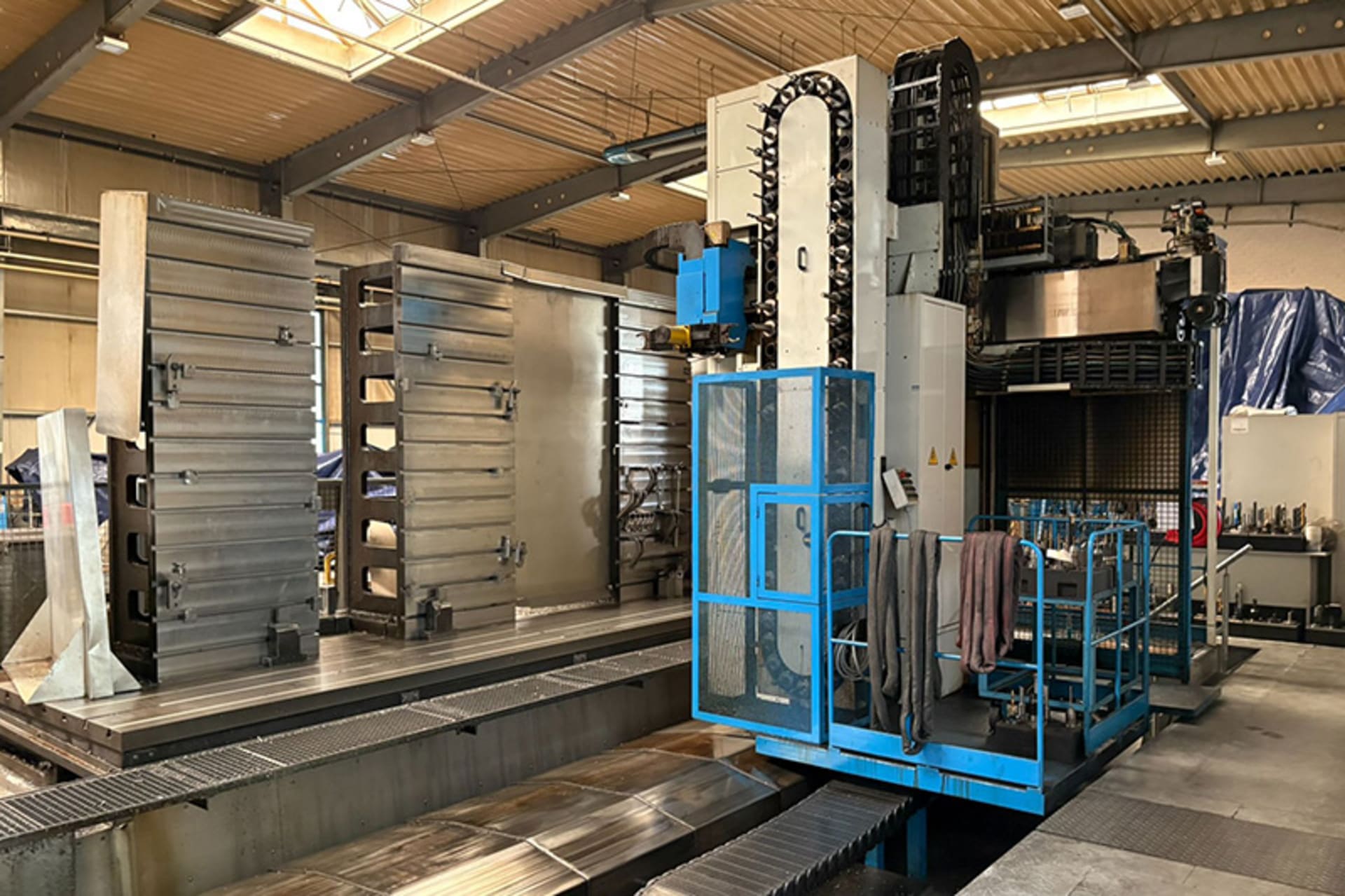
The travelling-column design allows the machining unit to move along large workpieces that remain clamped in place
4. Trusted Boring Machine Brands
Below are boring machine brands highly regarded for their precision, rigidity, and ability to machine large parts in heavy mechanical engineering.
FPT Industrie (Italy, 1969): Founded in 1969 in Italy, FPT Industrie specializes in medium- to large-sized CNC milling and boring machines. The brand is known for its KENTA line, which uses a monobloc structure and hydrostatic guideway technology, delivering high stability when machining large parts.
PAMA (Italy, 1926): Founded in 1926 in Rovereto, Italy, PAMA is one of the world's longest-established boring machine manufacturers. The brand is strong in combined boring-milling machines capable of performing multiple operations on a single machine for the power, aerospace, and machine-building industries.
UNION (Germany, 1852): Founded in 1852 in Chemnitz, Germany, UNION is one of Europe's oldest machine tool manufacturers. The brand specializes in heavy-duty horizontal boring machines, known for their ability to machine large, heavy parts.
SCHARMANN (Germany, 1885): Founded in 1885 in Rheydt (now Mönchengladbach), SCHARMANN is renowned for its high-rigidity horizontal boring machines. The FB and WF series are highly regarded for their durability and ability to maintain precision over long-term machining.
DMG MORI (Germany/Japan): Formed from Gildemeister (Germany) and Mori Seiki (Japan), DMG MORI is a global machine tool brand. It offers combined boring-milling machining centers known for high precision and automation capability.
TOS VARNSDORF (Czech Republic, 1903): Founded in 1903 in Varnsdorf, TOS VARNSDORF specializes in horizontal boring machines, machining centers, and large milling machines. Its WHN series is well known for handling heavy parts in the machine-building industry.
Mitsubishi Heavy Industries (Japan): A major Japanese industrial conglomerate, MHI develops large, highly stable machine tools. Its boring machines stand out for their sturdy construction, continuous-operation capability, and precision in heavy-duty machining.
5. Why Buy Used Boring Machines at ReMach
ReMach specializes in supplying used boring machines and industrial machine tools, with a focus on transparent, efficient, and sustainable transactions. For heavy-duty boring machines in particular, ReMach keeps machines in stock at its European warehouse so customers can directly inspect geometric accuracy, spindle condition, and the guideway system before purchase. Every machine undergoes detailed technical inspection by ReMach's team, providing a clear assessment of wear and heavy-duty machining capability. Combined with an international logistics network and the “Honest Trading” - “Responsible Tech” philosophy, ReMach delivers a safer and more reliable solution for investing in Used Boring Machines.
1. In-Stock Machines - Direct Inspection Before Purchase
ReMach maintains a European machine warehouse stocking multiple boring machine types, including Table-Type, Planer-Type, and Floor-Type, from brands such as PAMA, UNION, SCHARMANN, TOS VARNSDORF, and Mitsubishi. Customers can inspect the machines in person, watch them run, or request a test-run video before deciding, reducing the risk of buying through intermediaries.
2. Transparent Technical Inspection
Every boring machine at ReMach is checked for key factors such as geometric accuracy, spindle condition, guideways, ball screws, and mechanical backlash. Machines are also test-run to assess real operating performance. All results are compiled into a technical inspection report, giving customers a clear picture of machine condition before investing.
3. Optimized Investment and Operating Cost
Thanks to a direct European machine source and a professional logistics network, ReMach helps companies access quality boring machines at a more optimized cost than new equipment. ReMach also provides full-service support, from dismantling and packing to international shipping, export procedures, and installation, reducing total project cost and lead time.
6. How to Buy Used Boring Machines at ReMach
ReMach follows a 5-step process for buying used boring machines, helping companies select the right equipment, verify quality, and bring the machine into efficient operation.
Step 1 - Define Machining Needs: Identify the right boring machine type (Table-Type, Planer-Type, Floor-Type), workpiece size, material, required precision, output volume, and budget to avoid selecting unsuitable equipment.
Step 2 - Search and Evaluate Suitable Machines: Browse the Boring Machines catalog at ReMach, comparing factors such as brand, year of manufacture, axis travel, boring spindle diameter, table load capacity, control system, and equipment condition.
Step 3 - Check Machine Condition: Request a test-run video or inspect the machine directly at ReMach's warehouse to assess accuracy, axis backlash, spindle condition, guideways, and actual operating performance.
Step 4 - Quotation, Shipping, and Installation: Once a machine is selected, ReMach provides a complete quotation covering machine cost, dismantling, packing, shipping, import/export procedures, and on-site installation.
Step 5 - Handover and Commissioning: Finalize the contract, deliver the machine to the workshop, align and test-run it, and provide technical support to bring the equipment quickly into stable operation.
7. FAQs
How Is a Boring Machine Different From a Milling Machine?
A Boring Machine specializes in enlarging and finishing existing holes, ensuring concentricity and tight tolerances down to the micron level. A milling machine focuses on external surface machining: face milling, slotting, and part shaping. Many modern horizontal boring machines (HBM) integrate additional milling functions, but cannot fully replace a dedicated milling machine for complex surface machining
How Can I Tell If a Used CNC Boring Machine Is Still Accurate?
To assess the accuracy of a used CNC boring machine, check it in 3 steps: geometry, kinematics, and a machining test run. First, measure the squareness, flatness, and parallelism of the axes to determine the machine's “skeleton” condition. Next, check the spindle, backlash, and vibration during idle running. Finally, machine a sample part and re-measure it with a CMM to confirm actual accuracy.
Can a Used Boring Machine Be Upgraded to a Newer Control System?
Yes, a used CNC boring machine can be fully retrofitted with a new control system such as Siemens, Fanuc, or Heidenhain. This solution increases productivity, improves accuracy, and extends the machine's service life by 5-10 years. However, the outcome depends on the machine's original mechanical condition; machines with a sound structure are better candidates. If the machine frame is worn or deformed, the retrofit will not deliver the expected results.
How Are 20-30 Ton Used Boring Machines Shipped and Installed?
Heavy-duty boring machines are typically shipped by sea in open-top or flat-rack containers. After packing, the machine is securely fastened to ensure safety during the long transport journey. On arrival, specialized lifting equipment and a code-compliant concrete foundation are required for installation. The full process typically covers shipping, customs clearance, and on-site installation.
How Much Do Used Boring Machines Cost?
Used boring machine prices range from around €30,000 to over €400,000, depending on type, brand, and condition. Table-Type machines are generally cheaper than Floor-Type machines. Factors such as machine age, CNC controller, and included accessories significantly affect price. In addition, budget an extra 15-25% for shipping and installation.
How Long Does Delivery of Used Boring Machines Take?
Average delivery time is 35 to 70 days, depending on the shipping origin. In-stock machines typically take 3-7 days to ship out. Sea freight takes around 25-50 days, plus 5-10 days for customs clearance. Choosing a source closer to your region can shorten this to 2-3 weeks.
Should I Buy a Used Boring Machine?
Yes, with the right trusted supplier, a used boring machine is a solution that saves 30-60% in cost. It still delivers high mechanical durability and can be used reliably for many years. However, accuracy, maintenance history, and CNC condition must be carefully checked. This is an optimal choice for companies looking to reduce upfront investment.
Where Can I Buy a Reliable Used Boring Machine?
Choose a supplier with an actual machine warehouse, clear inspection standards, and the option for direct inspection. ReMach is one of the suppliers of used boring machines from Europe with a transparent inspection process. Every machine comes with a technical report and full-service shipping and installation support, reducing risk and ensuring investment efficiency.
Used boring machines from EU stock - especially brands like PAMA, UNION, and TOS VARNSDORF - are a practical solution for heavy mechanical engineering plants looking to expand machining capacity on a controlled budget. However, choosing the right machine type and a trusted supplier is what determines long-term operating efficiency.
ReMach supplies high-quality used boring machines from Europe, backed by transparent technical inspection and full-service support from shipping to installation. Alongside Used Boring Machines, ReMach also offers CNC Machining Centres solutions suited to a wide range of precision machining needs. Contact ReMach via Hotline +49 2196 7050573 for advice and a quote on the Used Boring Machines that best fit your production needs.
8. Glossary
Term | Explanation |
HBM (Horizontal Boring Machine) | Horizontal boring machine - a boring machine type with a horizontally oriented spindle, used to machine holes in large parts. |
Table-Type HBM | Horizontal boring machine with a movable table: the workpiece sits on a table that travels along the X and Z axes; the most common type in the HBM family. |
Planer-Type HBM | Gantry-type horizontal boring machine (T-Type): the workpiece travels along a long table, suited to machining parts 5 m or longer. |
Floor-Type HBM | Floor-type horizontal boring machine: the workpiece is fixed directly to the workshop floor, while the entire spindle unit moves to machine oversized parts. |
Spindle | The high-speed rotating component that holds the cutting tool. Spindle condition directly determines machining accuracy. |
Backlash | The gap between gears or between a ball screw and its nut when the direction of motion reverses. Excessive backlash reduces positioning accuracy. |
Retrofit | Upgrading an old CNC control system with a new one (Siemens, Fanuc, Heidenhain) while keeping the machine's mechanical structure unchanged. |
CMM (Coordinate Measuring Machine) | A 3D coordinate measuring machine - a high-precision instrument used to check tolerances after machining. |
Tolerance | The permitted deviation range from a nominal dimension, e.g., ±0.01 mm. The smaller the tolerance, the higher the required precision. |
Concentricity | The degree of alignment between the center of a machined hole and its theoretical center. A key parameter when boring precision-fit holes. |
T-Slot | A T-shaped groove on a machine table or workshop floor, used to secure workpieces with dedicated clamping bolts. |
Monobloc | A machine body cast as a single, unified structure, increasing rigidity and reducing vibration during heavy-duty machining. |
Hydrostatic Guideway | A guideway system that uses a layer of pressurized oil between sliding surfaces, resulting in almost no mechanical friction and extremely low wear. |
Open-Top / Flat-Rack Container | Special shipping container types: open-top has no roof (for tall cargo), flat-rack has no side walls (for bulky, heavy machinery). |
Laser Alignment | A technique for aligning machine axes using laser equipment, offering much higher precision than traditional mechanical alignment. |