
Breton MATRIX 1300 DY K30 Portal Milling Machine Gatry





- Storage Number
- 26019-870
- Machine type
- Portal Milling Machines
- Manufacturer
- Breton
- Type
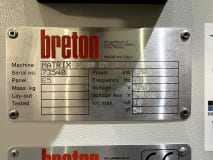
- MATRIX 1300 DY K30
- Year of construction
- 2020
- Location
- Langenfeld, Germany
- Documents
- Price
- On Request
- Control
- HEIDENHAIN iTNC 640 HSCI
- Dimensions (LxWxH) approx.
- 9500 x 10000 x 7000 mm
- Tool Changer
- yes
- Travel X-axis
- ≥ 4000 mm
- Travel Y-axis
- ≥ 4000 mm
- Travel Z-axis
- ≥ 1300 mm
- Weight approx.
- 90,000 kg
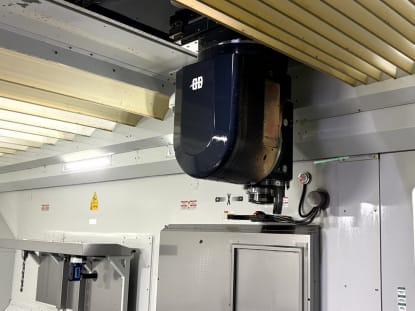
The BRETON MATRIX 1300 DY K30 is a 5-axis CNC gantry machining center with a movable gantry design for high-precision complete machining of large workpieces. The rigid steel construction, combined with direct measuring systems and high-dynamic axis drives, ensures high positioning accuracy and consistently stable machining quality.
The machine is equipped with a HEIDENHAIN iTNC 640 HSCI CNC control system, including AFC (Adaptive Feed Control), AVD (Active Vibration Damping), and CTC (Cross Talk Compensation). These functions optimize the machining process, reduce vibrations, and improve surface quality and process reliability.
The 40 kW high-speed spindle with up to 28,000 rpm features programmable internal cooling (IKZ) from 40 to 70 bar and is suitable for demanding milling operations on a wide variety of materials.
The equipment includes a direct-drive NC rotary table Ø 3,500 mm with a table load capacity of up to 15,000 kg. The custom rotary table plate is equipped with 16 AMF zero-point clamping modules, enabling short setup times and flexible workpiece clamping.
The machining center features an 80-tool magazine with HSK-A100 tool holder and an additional 3-tool pick-up magazine for large tools. A BLUM laser system for tool measurement and a wireless 3D probing system support automatic setup and monitoring of machining.
Additional equipment includes two Barberis chip conveyors, a 2,500-liter coolant processing system with drum filter, oil separator, and coolant cooling, automatic front doors, a camera system for workspace monitoring, a wireless handwheel, and the Breton Smart Start & Stop energy-saving system.
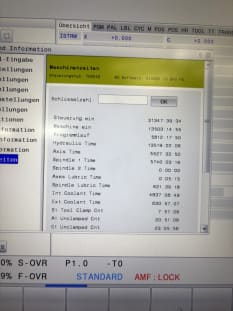
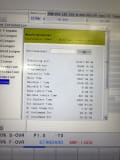
Control ON: 21,347 hours
Machine ON: 13,503 hours
Program runtime: 5,812 hours
Spindle runtime: 5,740 hours
- Transportation costs
- not included
- Terms of delivery
- EXW EX Works
- Terms of payment
- 100% prepayment before pick-up
Transportation costs are not included in the used milling machine price; terms of delivery and payment are stated under "Additional information" in each listing. You should also budget for installation and commissioning at the new site. In most cases, the buyer is responsible for organizing the transport; upon request, ReMach can check whether transport can be arranged or supported. ReMach also helps with dismantling, loading and export paperwork.
Choose the control your operators already know and that is compatible with your existing programs and CAM post-processors. On European machines the most common controls are Heidenhain (TNC, conversational Klartext programming), Siemens SINUMERIK and FANUC. The control version determines the available functions, such as 5-axis cycles, and the availability of spare parts.
The five axes are three linear axes, X, Y and Z, plus two rotary axes, usually two of A, B or C depending on the machine design. In 3+2 machining the rotary axes tilt the part to the required angle before the linear axes cut; in simultaneous 5-axis machining all five move together for complex freeform surfaces. A swivel head suits large, heavy parts, while a swivel-rotary table limits part size and weight to the table.
Choose by the size, weight and shape of your parts. A vertical machining centre suits small and medium parts in series; a portal milling machine handles large, heavy parts such as moulds and machine beds; a bed-type milling machine, with its table on a fixed bed, offers the rigidity for long parts and heavy cutting. A 5-axis machine is for complex parts machined on several sides with few set-ups, while a horizontal boring mill suits large prismatic parts with precise bores on several faces.
A machining centre is a CNC milling machine with a tool magazine and an automatic tool changer. This lets it perform milling, drilling, tapping and boring in one set-up without manual tool changes. The number of magazine positions in the listing shows how many tools a part can use.


Our Services
- Inspection & report
- Disassembly & installation
- Global logistics
- Customs & paperwork
- Sourcing & valuation
- Personal consultation
Related items
1. Portal Milling Machines: Design, Uses & Capabilities
A portal milling machine is a cornerstone of industrial manufacturing, designed for the precise machining of large workpieces across a wide range of materials. Its defining feature is a crossbar of adjustable height mounted between two vertical supports – a rigid portal structure that determines the maximum workpiece width and ensures exceptional stability throughout the machining process.
Height-adjustable crossbar limits maximum workpiece dimensions, accommodating a variety of large components
Effective face milling of large surfaces in a single setup
Widely used in mechanical engineering and heavy industry
The supports can be either fixed or movable, and most designs incorporate an adjustable clamping table for greater flexibility. Two additional milling heads mounted on the supports allow all sides of a workpiece to be machined in a single clamping operation, significantly reducing setup times and improving throughput.
The inherently rigid construction of portal milling machines enables very high dimensional accuracy – down to approximately 0.005 mm – with minimal vibration during operation. This results in excellent surface finishes and consistent quality across large workpieces. The robust design also allows for high cutting capacities, making portal milling machines the preferred choice for demanding applications in machine construction and heavy industry.
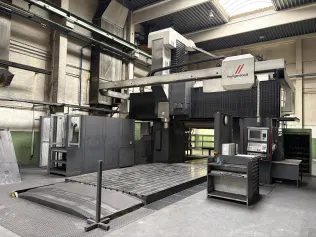
The image above shows a REICHLE & KNÖDLER portal milling machine in operation.
2. Portal Milling Machines: History and Development
Machine construction in Germany has deep roots, beginning with the founding of the first machine factory in Chemnitz in 1848, where early machine tools were designed and produced. One of the machine types to emerge from this tradition is the portal milling machine – a design that has continually evolved while retaining its core working principles.
The introduction of computer technology marked a turning point, bringing NC-controlled and later CNC-controlled portal milling machines to market. Today, the range of available machines spans compact models through to large-format systems capable of accommodating multi-ton workpieces on their machining tables.
3. Portal Milling Machines: Applications & Industry Uses
Portal milling machines are widely used in mechanical engineering and heavy industry. A typical application is the machining of cast steel and cast iron housings for transmissions, where precise face surfaces are essential to allow the housing to be flanged directly onto a motor. These machines are also well suited to heavy-duty machining of tool steel and titanium.
4. Portal Milling Machine Manufacturers & Brands
Several manufacturers have specialised in portal milling machines. Among the most reputable brands are FOREST-LINE, ZIMMERMANN, WALDRICH-COBURG, SNK, SCHIESS ASCHERSLEBEN, MAZAK, BOEHRINGER, MIKROMAT, TOS, and KOLB – each with a strong track record in producing high-quality, precision gantry milling equipment.
Used portal milling machines in good condition are widely available on the second-hand market, making it possible to acquire reliable, high-performance machinery at a fraction of the cost of new equipment.