
1. Saw Machines for Woodworking: Types & Uses
Saw machines are essential woodworking tools used at every stage of timber processing – from harvesting raw material in the forest to shaping finished wood products. Wood saws can cut through tree trunks in any direction, providing the ideal starting material for further processing. A wide variety of wood cutting machines have been developed to help industrial operations efficiently process large volumes of timber into virtually any product.
Definition of saws
Saws work through the processes of dividing and machining, using a toothed blade driven into and across the material via circular or oscillating movements. The blade itself can be flat or round. Circular saws offer higher cutting speeds and a mechanically simpler construction, though their cutting depth is limited to a maximum of 40–45% of the blade diameter. Greater cutting depths therefore require increasingly large blades, which can make handling more demanding.
For applications requiring deep cuts, bandsaws are generally the preferred choice. In timber harvesting, the chainsaw remains the most widely used tool and continues to play an important role in later stages of timber production and preparation.
2. Types of Saws & Peripheral Woodworking Machines
Wood travels from forest to sawmill before reaching the carpentry workshop for final processing. The further timber progresses along this chain, the greater the precision required of the cutting equipment. Each stage therefore relies on specific saw types, drawn from circular saw, bandsaw, and chainsaw product ranges.
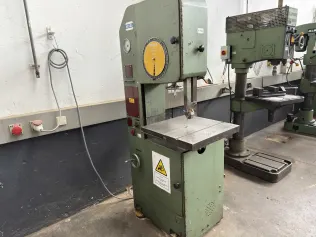
Bandsaws
The cutting unit within a bandsaw consists of a loop-shaped metal belt with teeth along one edge, clamped between a drive roller and a tensioning roller. Electrically driven and available in a wide range of sizes, bandsaws serve different purposes at different stages of production. In the sawmill, they trim logs lengthwise into planks and boards; in the carpentry workshop, they cut long beams to the required width. Their technical simplicity makes them reliable workhorses across the industry.
Well-known bandsaw manufacturers include FELDER, GEWEMA, HEMA, and PEHAKA.
Scroll Saws
Scroll saws are a variation of the bandsaw concept. Instead of a flat belt, they use a thin cutting wire that allows operators to produce intricate curves and cut workpieces radially from a given material – the industrial equivalent of a fret saw. Popular manufacturers include BLITZ, FROMMIA, HEGNER, and SCHEPPACH.
Combined Trimming Saws
Combined trimming saws machine board materials on both sides within a single work cycle, making them particularly effective for batch processing precise workpieces. On a technical level, they consist of a circular saw fitted with two blades that can be aligned with high accuracy. In recent years they have largely been superseded by panel-dividing systems and sliding table saws, and are no longer in production – though they remain available on the second-hand market at very competitive prices. The best-known manufacturers were BÄUERLE, BARBERAN, and OMGA.
Sliding Table Saws
Sliding table saws are the standard choice for carpenters and joineries. They deliver extremely precise, linear cuts in panels and board materials, with a broad range of settings covering maximum and minimum panel dimensions as well as accurate mitres and angles. The sliding table saw was invented by German company ALTENDORF, which remains the market leader in this category. Other respected manufacturers include CASOLIN, FELDER, MARTIN, PANHANS, and SCM GROUP.
Mitre Saws
Mitre saws produce 90° cuts into wooden profiles and strips, creating the precise joints widely used in parquet and laminate flooring. The term often covers both mitre and cross-cut functions, as many machines combine both capabilities. Smaller models are compact enough to be transported between job sites, while heavier stationary versions – designed for workshop use – can produce mitre cuts on both sides of a profile in a single cycle. Popular manufacturers include ELUMATEC, FOM, RAPID, and STRIFFLER.
Cross-Cut Saws
Cross-cut saws shorten long materials in a variety of ways, though unlike standard circular saws they are limited to cutting the short side of a slat or narrow board. The cutting angle can be adjusted in both width and depth, offering considerable flexibility. The machine consists of a table with a rotary adjusting unit for the blade and a return mechanism mounted above it. The workpiece is clamped onto the table, the saw is set to the required parameters, and a hand-operated lever pushes it across the material to produce clean, precise cross-cuts. Leading manufacturers include ELU, MAKITA, METABO, and OMS.
Panel Saws
Panel saws are designed for efficiently dividing large panel and board materials, and are widely used by furniture manufacturers and in timber retail environments. They typically operate with one or more circular saw units and can be extended with additional equipment such as a turnover station, allowing panels to be processed on both sides and then stacked on completion. Among the best-regarded manufacturers are HOLZMA, HOMAG, GIBEN, SCHELLING, and STRIEBIG.
Multi-Blade Saws
Multi-blade saws cut boards, panels, and chipboard to size simultaneously. Depending on the machine type, they can produce multiple strips in one or several widths within a single work cycle. They are primarily suited to thinner timber dimensions and are not intended for materials more than a few centimetres thick. Popular manufacturers include RAIMANN and ABMI.
Feeding & Stacking Equipment for Sawing Machines
Efficient log and panel processing depends on high-performance transport systems. The most common are roller tracks, conveyor belts, and turnover stations, which ensure materials are correctly positioned at each stage of the sawmill or panel cutting operation. Clamping and holding mechanisms – including magnets and grippers – keep material secure during cutting, while vacuum lifters handle more delicate panels and boards without causing surface damage. Leading producers of feeding and stacking systems for wood cutting equipment include FRILUMAC, RBO WINSTORE, and SIRIO.
Complete Sawmills
Sawmills are heavy-duty installations that break down tree trunks into boards and planks, collecting wood chips for onward processing according to their quality grade. Many sawmills are also equipped with veneer peeling machines, enabling trunks to be processed directly into veneer sheets. Bandsaws and circular saws form the backbone of most sawmill operations. Well-regarded manufacturers of complete sawmill systems include SERRA and BRENTA.
3. Buying a Wood Saw Machine: What You Need to Know
Before purchasing a wood saw, it's essential to consider the intended application carefully, as the range of available machines is extensive and each type is suited to specific tasks.
Chainsaws are the preferred choice for timber harvesting, while circular saws excel in construction site environments. For interior joinery and finish work, cross-cut and mitre saws deliver the best results. Across all categories, one principle holds true: prioritise quality over price. Wood saws from established manufacturers tend to be more powerful and reliable, making them the better long-term investment in professional settings.
For carpenters and joiners, the sliding table saw is often the most versatile option. When evaluating these machines – particularly used models – the equipment and features fitted are frequently more important than raw performance figures. While basic sliding table saws offer a broad range of processing options, their manual operation makes them less suitable for high-volume or serial production. Modern machines often include advanced features that simplify even complex applications, and many used woodworking machines built within recent decades include digital operator assistance.
In hardwood and exotic timber processing, the bandsaw stands out as the preferred tool – it delivers consistent cut thickness and minimal material waste. When assessing a bandsaw, cutting speed is the primary performance indicator, followed by feed rate on motorised models. It's also worth noting that different bandsaw types are not universally compatible with all wood species, so the intended application should guide the selection.
Sawmills occupy a different category entirely – these are heavy-duty machines designed for rough-cutting large tree trunks outdoors, often in demanding weather conditions. The circular saws, bandsaws and chainsaws used in sawmill operations offer basic cutting quality and approximate dimensional accuracy rather than precision results. What they do provide is exceptional strength and reliability when processing high volumes of hard or damp wood.
Buying Second-Hand
Professional woodworking saws are robust, long-lasting machines, and serious structural damage to the machine table or base frame is relatively uncommon. On a technical level, these machines are straightforward: the cutting unit – whether a circular saw or bandsaw blade assembly – is usually simple to dismantle, clean and service at modest cost.
In recent years, significant efficiency gains across the industry have created a healthy supply of quality used machines, as older models are replaced with higher-performing equipment. Thanks to the inherent durability of leading saw brands, however, many of these second-hand machines remain capable of productive operation for years to come.