
1. Metal Sawing Machines: Processes & Applications
Metal sawing machines are versatile cutting tools used across a wide range of production processes. Key characteristics include:
Cutting rod and bar material to length with high precision
Classified by design type and the cutting tool used
Different saw types suited to specific materials and applications
The saw is one of the most established tools in metal cutting, capable of producing a variety of geometrical cuts depending on the tool configuration. Certain metal separation tools are closely related to metal saws in terms of application and operating principle, though they do not produce geometrically defined cuts in the same way.
The cutting motion in metal sawing is generally intermittent, although continuous cutting action is also possible in some machine types. Metal saws are primarily used for cutting workpieces to length, but many models are equally well suited to producing external contours or internal profiles through a pre-cut opening in the workpiece.
2. Types of Metal Saw: Industrial Sawing Machines Guide
In industrial production processes, rod material is cut to length and machined into various shapes using a range of industrial sawing machines. The different types of metal saw are categorised according to their design and the cutting tool they use.
Hacksaws
The hacksaw is a traditional and versatile metalworking tool, available in a variety of sizes. Its blade is clamped into two openings at opposite ends of a C-shaped frame. The cutting action is intermittent, featuring both a working stroke and an idle stroke – as the blade returns, it lifts slightly to pause the cutting process.
Well-known manufacturers of hacksaws include BEHRINGER, KASTO and KLAEGER.
Bandsaws
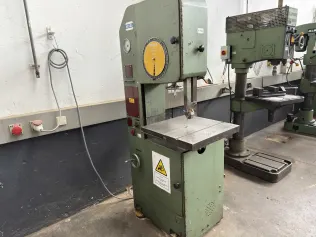
Bandsaws are highly efficient industrial saws valued for their low material waste and high processing speeds. Models range from conventional manual machines to fully automated NC and CNC sawing machines.
The bandsaw's continuous cutting motion is made possible by an O-shaped blade that runs between two wheels. This design does restrict the working area on one side, but the machine is available in both vertical and horizontal configurations to suit different industrial applications.
Leading bandsaw manufacturers include BAILEIGH, BEHRINGER, JAESPA and MEBA.
Circular Saws
The circular saw also delivers a continuous cutting motion, using a toothed disc that rotates at high speed. While it is limited to straight cuts, its cutting performance and throughput make it a popular choice for demanding metalworking tasks.
Prominent circular saw manufacturers include BEHRINGER, EPPLE, FORTE, KALTENBACH and OPTIMUM.
Double Mitre Saws
Where mitre cuts are required on both ends of a workpiece simultaneously, the double mitre saw is the purpose-built solution. Belonging to the circular and cross-cut saw family, these machines use two saw heads to produce parallel mitre cuts in a single operation.
Notable double mitre saw manufacturers include EISELE, ELU, RAPID and WEGOMA.
Separating Machines
Although not technically saws, separating machines are widely used in metalworking as an effective cutting solution due to their versatility and operating principle.
These machines are available in numerous configurations for industrial use and are particularly suited to cutting large volumes of metal profiles to a consistent length. Key performance requirements include dimensional accuracy, durability and cutting speed. At their core, separating machines consist of a rotating cutting disc driven by a high-performance motor.
3. What to Look for When Buying a Metal Saw
All metal cutting saws feature an effective cooling unit to maintain cutting performance and prevent excess heat from building up in the blade and workpiece. This significantly extends tool service life. Nevertheless, metal saws operate under intense strain and should be thoroughly inspected before purchase.
A careful pre-purchase inspection makes buying a used metal saw a straightforward process. It is also worth considering blade wear, as saw blades require regular replacement to maintain cutting precision and accuracy.
Used industrial metal saws are widely available on the second-hand market, often in near-perfect condition at a fraction of the original price – making them a cost-effective choice for workshops and production facilities alike.