
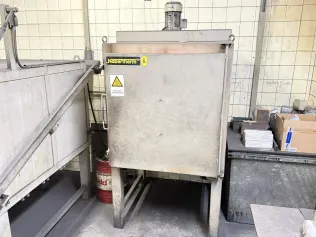
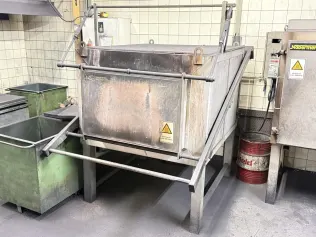
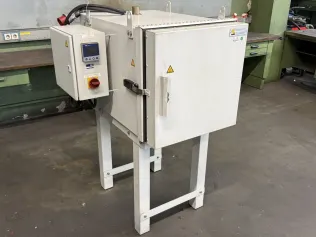
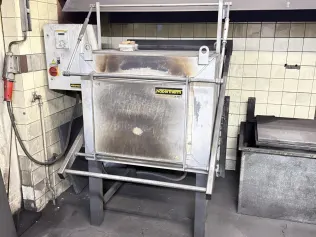
1. Industrial Furnaces for Heat Treatment & Metal Processing
Industrial furnaces are essential for heat treatment, metal separation, and the precipitation of non-ferrous metals. Available in a wide range of sizes, they serve both small workshops and large-scale manufacturing operations. Common applications include the recycling and recovery of valuable non-ferrous metals such as copper, lead, aluminium, and zinc.
Large industrial furnace systems typically incorporate conveyor systems, processing plants, flue gas treatment equipment, and heat recovery units. Many manufacturers also offer integrated automation as standard, making these machines particularly well-suited to high-volume non-ferrous metal production environments. Smaller furnace models remain a practical choice for hardening shops and compact workshop settings.
2. Basic Construction of an Industrial Furnace
The basic construction of a furnace begins with a structural frame, to which the oven chamber is mounted. The interior consists of multiple insulation layers and heating elements, ensuring efficient thermal performance. Even swing-down or swivel-type covers incorporate insulation. An emergency vent is included as a standard safety feature.
The electrical supply is housed in a separate control cabinet. A digital controller is now standard, displaying the difference between set-point and actual values and regulating furnace operation. Timer functions and PC connectivity are also commonly integrated.
3. Furnace History: Origins and Industrial Development
The furnace has its roots in the need to separate precious metals from raw materials – a requirement that emerged early in human history. Over time, its role evolved significantly, and today furnaces are primarily used in recycling applications. Compact, high-efficiency models allow specific materials to be recovered at a high level of purity, while larger industrial versions serve as the backbone of modern recycling systems.
4. Furnace Applications: Key Uses and Industry Examples
Furnaces are most commonly used for recovering lead from car batteries, separating electronic waste and old cables, and recycling electric motors. Digital programming allows modern furnaces to achieve precise temperature control, ensuring the exact melting point of each target metal is reached consistently.
5. Leading Furnace Manufacturers & Brands
Several companies have built strong reputations in the manufacturing of furnaces. Among the most respected names in the industry are NABERTHERM, KSK, SOLO SWISS GROUP, ENETEX, OTTO JUNKER, ABB, ACAT, and HEINRICH GRÜNEWALD.
The market for used furnaces is regularly refreshed with new listings, making it straightforward to find quality machinery at competitive prices.