
 This item is sold
1. Press Brake: Precise Bending with Matching Punch and Die
A press brake is used to bend and shape sheet materials into precise forms. Using a matching punch and die, it produces the bends required for machinery components, cladding, and casings – and is also known as a folding press, bending press, or break forming press.
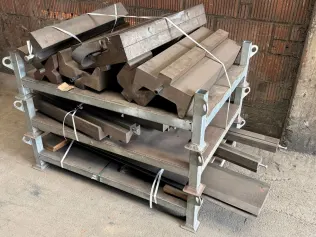
Lowering the punch presses the sheet or panel into a recess, bending it into the desired shape. By repositioning the sheet and repeatedly lowering the punch, complex profiles can be produced without reconfiguring the machine.
Three bending methods are commonly used. Air-bending is the most widely used technique, allowing operators to achieve a variety of angles without changing the tool. Bottoming delivers excellent precision but is limited to a single bend angle. Three-point bending offers greater accuracy and, depending on the equipment, can accommodate different angles without a tool change. Folding an envelope profile is typically carried out in two steps: pre-punching via air-bending, followed by a final pressing stage.
- Also known as a folding press or bending press
- Enables sheet materials to be bent into precise shapes
- Widely used in the manufacture of furniture, doors, and cladding for electrical components
2. Press Brake Safety: From Manual to CNC Technology
The rolling of sheet metal and press braking first became possible in the late 17th century, following the development of effective rolling processes. Early sheet metal press brakes were entirely hand-operated and demanded considerable physical effort. As automation advanced, the work became less physically demanding but introduced new safety challenges. Press brakes manufactured up to 2002 typically featured a two-hand operating switch, designed to prevent the operator's hands from being caught in the closing movement. The drawback of this approach, however, was that it left operators unable to hold or guide sheet metal into the machine.
CNC Hydraulic Press Brakes
Modern CNC press brakes address these limitations through a combination of holding arms and optical monitoring systems positioned at the base of the punch. Most electric press brakes use laser beams for continuous monitoring – if an obstacle breaks the beam, the machine stops automatically. Today's CNC brake press technology takes on much of the operational workload independently, requiring only minimal input from the operator and significantly reducing the risks associated with machine use.
3. Press Brake Applications Across Industries
Press brakes and bending machines serve an exceptionally wide range of industries and applications. In furniture and interior manufacturing, they are used to form panel materials into shelving, doors, and cabinetry. In the electronics and machinery sectors, they produce precision housings for electrical devices and protective cladding for industrial equipment. Press brakes are equally essential in the production of kitchen utensils, restaurant equipment, and medical facility fittings. Beyond these, they play a key role in roofing and facade construction, partition wall manufacturing, and the fabrication of components for elevators and escalators.
4. Press Brake Manufacturers: A Complete Overview
When sourcing a press brake, several manufacturers have established strong reputations for quality and reliability. AMADA, LUTHER, and Hungarian machine builder DIGEP are all well regarded in the industry. Machines from EHT, TRUMPF, and LVD are also worth considering – their used press brakes are particularly well regarded for performance and longevity. As with any used sheet metal machinery, a thorough visual inspection before purchase is essential.
5. Used Press Brakes for Sale – CNC, Hydraulic & Conventional
Finding a quality used press brake at the right price is straightforward when you know where to look. The available range covers conventional, CNC and hydraulic press brakes across a variety of sizes and capacities, making it easy to find a machine that suits your production requirements. Whether you need a compact model for lighter work or a heavy-duty hydraulic press brake for demanding bending operations, the second-hand market offers strong value across the board.
Used press brakes listed here are generally in good to very good condition. Where possible, the functionality of each machine is inspected prior to listing, and an extensive gallery of photographs accompanies each entry so you can assess the condition of any press brake before making a decision.