

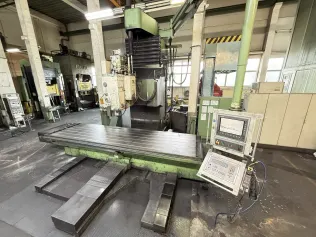
1. Bed-Type Milling Machine: Structure & Key Features
A bed-type milling machine is built around a stable, low-vibration machine bed on which the workpiece is securely mounted. Workpiece clamping is achieved through a variety of methods, including clamping slots, clamping claws, and corresponding fastening screws. The clamping system can be mechanical, hydraulic, electric, or pneumatic, offering flexibility across different production environments. Unlike quick-clamping devices, this design allows large and heavy workpieces to be machined without any risk of tipping.
In most configurations, the machine bed also serves as the worktable, which minimises vibration during operation and extends cutting tool life. One or two machine stands hold the tool units, enabling multiple faces of a component to be machined in a single setup. Bed-type milling machines are available in horizontal, vertical, and universal configurations, making them suitable for a wide range of milling applications.
- Available in horizontal, vertical, and universal configurations
- Rigid machine bed minimises vibration and extends cutting tool life
- Capable of machining large, heavy components and machine casings in a single setup
2. Bed-Type Milling Machines: A Long Industrial Tradition
Bed-type milling machines have been a cornerstone of industrial metalworking since the early days of industrialisation. Today, many manufacturers continue to produce conventional designs of this versatile machine, while advances in technology have introduced a broad range of modern variants. CNC bed milling machines, for example, feature a mobile worktable and precision computer-controlled movement, combining traditional robustness with contemporary accuracy. Multi-tool machining heads are now considered standard, allowing manufacturers to process workpieces efficiently in a single setup.
MTE bed-type milling machine in use
3. Bed-Type Milling Machines: Applications & Capabilities
CNC bed-type milling machines are widely used across industrial sectors thanks to their versatility and precision. Unlike conventional horizontal or vertical bed mills, the universal variant can process workpieces in multiple directions, making it exceptionally adaptable for complex machining tasks.
When working with very long workpieces, dual-column configurations significantly reduce setup time by allowing both machine stands to drive the milling head simultaneously. A key consideration with this setup is collision detection – the CNC control system automatically halts axis movement whenever a potential collision is detected within the machining zone, protecting both the tooling and the workpiece.
These machines are particularly well suited to the production of large, heavy components such as machine housings, structural parts, and industrial casings. Typical applications include the milling of flat surfaces and bearing seats, as well as the precise machining of external contours and complex geometries.
4. Used Bed-Type Milling Machines: Top Brands & Buying Guide
The European market offers a wide range of bed-type milling machines to suit diverse machining requirements. German manufacturers such as MAHO, RECKERMANN, SCHELLER and BERLETT produce highly regarded universal bed mills, while the global supply of both new and used machines remains strong.
Swiss manufacturer REIDEN and French brand HURON are also well worth considering. Many of these machines are CNC bed mills equipped with control systems from leading providers such as SIEMENS, HEIDENHAIN or FANUC.
Used bed-type milling machines from the brands mentioned above are frequently available in excellent condition on the second-hand market, often representing strong value compared to new equipment.