
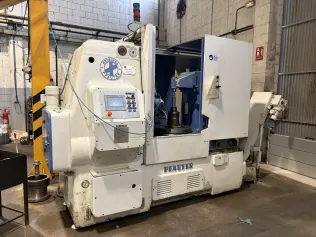
1. Hobbing Machines: Gear Manufacturing for All Types
Hobbing machines, also known as hobbers, are specialised machines designed for the precision production of gears. Using the machine's various settings, operators can configure the number of teeth, helix angle and profile correction to exact specifications. The hobber engages single or multiple-gear worms with the workpiece to form a worm gear unit, while the rotary cutting motion is driven by the turning milling tool. As the tool advances alongside the workpiece, it generates the tooth space – enabling the production of both spur and helical gears.
- Manufacture of gears across all types and forms
- Suitable for components used across a wide range of industries
- Exceptional dimensional accuracy and repeatability
The versatility of a hobbing machine makes it well suited to producing gears and splines to the highest levels of precision. As metal removal gradually wears the milling tool, it is continually shifted to bring fresh cutting edges into contact with the workpiece, ensuring consistent tooth quality throughout the run. Once the tool is fully worn, it is resharpened using a specialised grinding machine, extending its working life and maintaining process efficiency.
2. Hobbing Machines: From Concept to Modern Implementation
Hobbing machines were first conceived in 1856 by Christian Schiele, though automating the process remained beyond the technology of the era. In 1887, George Bernard Grant — an inventor best known for his work on mechanical calculators — filed the patent for the first true hobbing machine. The pivotal breakthrough came with a universal hobbing machine developed by Hermann Pfauter of Chemnitz, founder of the renowned PFAUTER brand.
Hobbing machine in use
3. Gear Hobbing: Industrial Applications & Key Products
Gear hobbing machines produce a wide range of gear types, including outer spur gears, helical gears, and inner gears across various sizes. The process also supports the manufacture of bevel gears, crown wheels, palloid and hypoid gearing, Gleason and Klingelnberg tooth systems, as well as screw augers and worm wheels.
These components are used across the automotive industry, agricultural technology, mechanical engineering, and plant construction. Tooth width and helix angle can be adjusted with precision through straightforward tool settings, while the continuous cutting action – with no back stroke – produces chips efficiently and consistently.
The hobbing process delivers high dimensional accuracy, making it well suited to demanding applications. Where tighter tolerances are required, workpieces are typically hardened and then finished by grinding or honing.
4. Hobbing Machine Suppliers: LORENZ, PFAUTER & More
Leading hobbing machine manufacturers include well-established names such as LORENZ, PFAUTER, and KLINGELNBERG, each recognised for their precision engineering and long-standing expertise in gear cutting technology.