
1. Gear Cutting Machines: Industrial Applications & Processes
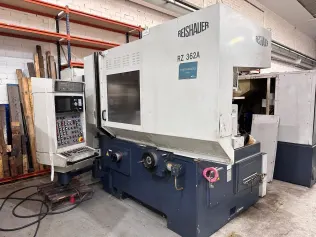
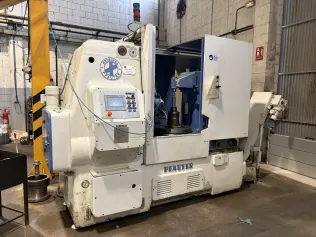
Gear cutting machines play a central role in the production of gear wheels and gear racks for the machine-building and automotive industries. Manufacturing typically involves two stages: milling followed by grinding. The appropriate machine type is selected based on the intended application and the geometry of the component required.
For milling gear wheels, hobbing is the most widely used process. It handles high volumes efficiently, deburring and sharpening gear edges with precision. Hobbing machines are equipped with NC or CNC controls, which simplify operation and improve repeatability. These machines produce external teeth, spur gears, and helical gears, and can accommodate internal helical gears on workpieces with larger diameters. Crown wheels and bevel gears are also within their capability. For smaller internal gears, hobbing is combined with specialist machines to achieve the required geometry.
The hobbing machine's flexible configuration allows it to accept a wide range of tooling arrangements, making it adaptable across diverse production requirements. A robust machine body houses the key components: the hob drive, the movable clamping slide or chuck for securing the workpiece, and an integrated cooling system. Machines are available in both horizontal and vertical configurations.
For applications demanding particularly precise tooth flanks, a two-stage approach is used: the gear wheel is first milled, then hardened, before a dedicated tooth flank grinder produces the final contours to the required specification.
2. Industrial Gear Cutting Machines: A Brief History
The gear cutting machine has shaped modern manufacturing since its earliest incarnations in the nineteenth century. The hobbing process was first invented in 1856, and the first purpose-built machines for gear wheel production followed in 1887. By the close of the century, the technology had matured considerably, giving rise to the first universal hobbing machine – a versatile tool capable of producing both spur and helical gears, with its operational range being the only meaningful limitation. Today, gear cutting machines are equipped with CNC controls, enabling high-precision output across a wide range of industrial applications.
3. Gear Cutting Machines: Applications and Industry Examples
Gear cutting machines are essential for producing gear wheels and gear racks across a wide range of industrial sectors. They play a particularly important role in the manufacture of transmissions – a critical component in automotive production and many other industrial machines – where precision and high-volume output are key requirements.
4. Leading Gear Cutting Machine Manufacturers
Several companies have established themselves as leading specialists in gear cutting machine manufacturing. Among the most respected names in the industry are Höfler, Pfauter, Praewema, TOS, Liebherr Verzahntechnik, and Samputensili (now part of the MAG Group).