
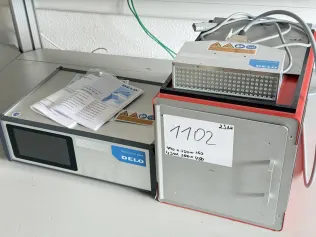
 This item is sold
1. Laboratory Technology for Industrial Quality Control
High-end laboratory technology is essential for analysing product characteristics and monitoring manufacturing processes across a wide range of industrial applications. Modern laboratory environments bring together an extensive selection of equipment – from stirrers, shakers, and magnetic mixers to freezers, ovens, and incubators – all supporting rigorous experimentation, process monitoring, and quality control.
Analysis and monitoring of product characteristics throughout the production cycle
A broad range of components covering measurement, storage, and processing needs
Quality control for both incoming materials and finished goods
Industrial laboratories play a central role in quality assurance, evaluating incoming and outgoing goods as well as driving product development and improvement. Effective laboratory operations depend on a diverse range of equipment beyond standard machines, including measuring and evaluation devices, gas chromatographs, laboratory scales, rotary evaporators, ultrasonic baths, vacuum pumps, and centrifuges. Specialist glassware, ceramics, and plastics are equally important for day-to-day operation, storage, and specific analytical processes.
Automated laboratory systems are increasingly common in industrial settings, particularly for repetitive or high-volume processes. Originating in the chemical industry as a cost-saving measure, laboratory automation integrates computers, sensors, and measuring devices to manage and steer specific workflows through metering and support equipment. In the food and beverage sector, automated laboratory devices are often integrated directly into production lines, with actuators such as pumps, valves, and robotic systems adjusting machinery in real time based on measurement data. These values are continuously compared against predefined specifications, enabling immediate corrective action. Process control and feedback technology work in close coordination to maintain consistent output quality.
2. Laboratory Technology: Applications & Industry Examples
Laboratory technology plays a central role in the food, chemical, and metalworking industries. In metal processing, it is used to monitor the material properties that result from heat treatment and other thermal or chemical processes – verifying that each workpiece meets the required specifications. Material monitoring is one of the most critical functions of industrial laboratory technology, as it ensures consistent production quality and helps prevent defects in the finished product.
For example, by analysing the composition of tool steel and evaluating specific hardening processes, manufacturers can confirm that the final material structure meets defined performance requirements.
3. Leading Laboratory Technology Brands & Manufacturers
A number of companies have established themselves as leading manufacturers of laboratory technology. Some of the most respected names in the industry include BINDER, BIOCHROM, BRABENDER, BÜCHI, COPERION, DADE, ELGA, EPPENDORF, GFL, IBS, IKA, KRAUSSMAFFEI, MEMMERT, METROHM, NIKON, PANASONIC, PERKINELMER, SARTORIUS, SIEMENS, TETRA, and WATSON-MARLOW.