
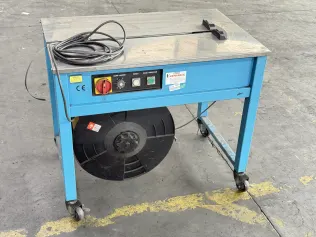
1. Packaging Machines for Industry and Commerce
Packaging machines play a central role in modern manufacturing, enabling efficient, cost-effective packaging across both private and public sector industries. Whether handling mass production runs or specialised applications, the right equipment ensures consistent output and quality at every stage of the process.
Industrial packaging machines are designed around a few core principles: high-volume production capability, sector-specific construction, and deployment across storage and distribution environments. Their versatility makes them indispensable in warehousing, logistics, and production facilities alike.
Depending on the application, packaging materials are either fed directly into the machine or produced on-site. Bottle filling lines for PET bottles, for example, receive raw granulate and form the finished containers within the same system. Each machine is purpose-built for its specific task.
There are two primary categories of packaging. Cardboard packaging is typically produced using punching machines that draw material from a roll and cut it to shape. Plastic packaging, by contrast, is manufactured through injection moulding or thermoforming processes, with the machine equipped accordingly for either method.
Beyond production output, packaging machines deliver significant value through automation – reducing labour costs and minimising errors across the manufacturing line. A standard machine consists of a robust frame housing all key components: loading devices, stacking and lifting mechanisms, conveyor systems, and integrated control units. Together, these elements keep production running smoothly and support quality assurance at scale.
2. History of Packaging Machines in Industry
Packaging has become an essential part of modern commerce. What was once done entirely by hand is now handled by purpose-built packaging machines designed for specific applications. Innovative packaging technologies protect products during transportation and storage, while also serving as a powerful marketing tool that supports brand identity and drives sales.
The first packaging machine was introduced more than 150 years ago in southern Germany – though the concept of protective packaging itself is far older. Today, virtually every manufacturing company operates a warehouse with a dedicated delivery and packaging department, and modern machinery plays a central role in keeping those operations efficient and cost-effective.
3. Packaging Machines: Applications and Examples
Packaging processes take many forms and are used across virtually every manufacturing sector. Packaging machines are employed in a wide range of applications – from wrapping pallets in stretch film to forming and filling blister packs with precision and efficiency.
In the food industry, sausage production relies on bagging machines with fumigation capabilities to extend shelf life and maintain product freshness. Equally important is the packaging of pastes and liquid food products, which requires a sterile, germ-free environment to meet hygiene and safety standards.
4. Leading Packaging Machine Manufacturers
Several companies have established strong reputations in the manufacturing of packaging machines. Among the most respected suppliers in the industry are Bosch Packaging Technology, PFM Verpackungsmaschinen, Rowa Verpackungsmaschinen, Lachenmeier, Bargstedt, and Blipack.