
Sort by:
Laichingen, Germany
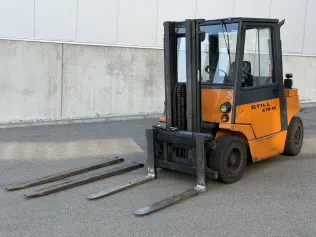
STILL R70-40 Diesel Forklift
Product Category Information
1. Diesel Forklifts: Applications, Features & Specifications
Diesel forklifts are used across virtually every industrial sector where palletised loads need to be moved – from loading bays and factory halls to large outdoor storage facilities. Built around a sturdy frame mounted on three or four wheels, these machines typically feature a rear-wheel steering mechanism that delivers a tight turning radius, roughly equivalent to the vehicle's own length.
Four-wheeled diesel forklifts offer greater lateral stability thanks to a lower centre of gravity. To maximise this stability, the wheels and axles run without suspension. Instead, stabilisers and vibration dampeners are commonly fitted to reduce swaying under heavy loads, while specialised forklift tyres absorb much of the impact that a conventional suspension system would otherwise handle.
The operator sits in a weight-adjustable suspended seat for comfort during extended use. Controls consist of foot pedals, hand levers, and a steering wheel – though certain models replace the conventional setup with joystick steering. Modern machines are increasingly equipped with touchscreen displays that show key operating parameters and unlock additional functions.
The combustion engine is positioned at the rear of the vehicle, where its mass acts as a natural counterweight when lifting heavy loads. The hydraulic lifting framework accommodates a standard fork or a range of alternative load-bearing attachments, making diesel forklifts highly adaptable to different handling tasks.
Common applications and variants include:
Four-wheeled diesel forklifts offer greater lateral stability thanks to a lower centre of gravity. To maximise this stability, the wheels and axles run without suspension. Instead, stabilisers and vibration dampeners are commonly fitted to reduce swaying under heavy loads, while specialised forklift tyres absorb much of the impact that a conventional suspension system would otherwise handle.
The operator sits in a weight-adjustable suspended seat for comfort during extended use. Controls consist of foot pedals, hand levers, and a steering wheel – though certain models replace the conventional setup with joystick steering. Modern machines are increasingly equipped with touchscreen displays that show key operating parameters and unlock additional functions.
The combustion engine is positioned at the rear of the vehicle, where its mass acts as a natural counterweight when lifting heavy loads. The hydraulic lifting framework accommodates a standard fork or a range of alternative load-bearing attachments, making diesel forklifts highly adaptable to different handling tasks.
Common applications and variants include:
- In-house transport of palletised goods within warehouses and production facilities
- Outdoor yard operations on uneven or rough terrain, where diesel power excels
- Side loaders and reach trucks for narrow-aisle environments
- Multi-directional forklifts capable of moving forwards, sideways, and diagonally for handling long or awkward loads
2. Diesel Forklifts: History, Development & Capabilities
The first diesel forklift was developed in 1917 for the transportation of pallets, with core operating principles that remain largely unchanged today. As automated warehousing systems evolved, stacking guide systems emerged alongside a growing shift toward electrically operated models for indoor applications.
Today, diesel forklifts are the preferred choice for heavy-duty and high-volume operations. Standard models handle lifting capacities of 1–8 tons, typically reaching heights of around 6 metres, while specialist versions can achieve lifting heights of up to 12 metres.
Today, diesel forklifts are the preferred choice for heavy-duty and high-volume operations. Standard models handle lifting capacities of 1–8 tons, typically reaching heights of around 6 metres, while specialist versions can achieve lifting heights of up to 12 metres.
3. Diesel Forklifts: Applications and Key Use Cases
Diesel forklifts are primarily designed for outdoor use. Unlike electric models, which are generally preferred indoors due to emissions regulations, diesel forklifts excel in open or well-ventilated environments. Typical applications include internal logistics operations, port and freight handling, and the loading and unloading of trucks and rail wagons.
4. Diesel Forklift Brands & Leading Manufacturers
A wide range of established manufacturers produce diesel forklifts to suit various industrial applications. Leading brands in this sector include Linde Material Handling, Jungheinrich, Still, Mitsubishi, Yale, Hyster, CAT, Heli, Komatsu, Shantui, Clark, TCM, AUSA, HC and Paus.