
1. Electric Forklifts: Benefits, Power & Key Advantages
Key advantages of electric forklifts include their near-silent operation, which makes them ideal for noise-sensitive environments, and their emission-free performance, which allows safe use in enclosed or indoor spaces. They are also available in a variety of sizes and load capacities, offering flexibility across different warehouse and logistics settings.
2. Electric Forklifts: Types, Sizes and Lifting Capacities
At the most compact end of the scale, hand-operated electric pallet trucks offer a practical solution for moving heavy loads in confined spaces. These machines require no driver's cab – the operator walks behind the unit, guiding it through narrow aisles and tight storage areas.
A step up in capability, the reach truck is operated by a standing driver, allowing smooth forward and backward movement and confident navigation of restricted corridors. For lighter applications – such as grocery distribution – smaller battery-powered models with carrying capacities of just a few hundred kilograms are widely available.
Larger warehouse and industrial environments are served by a broad spectrum of electric forklift types and lifting capacities. Specialist configurations have expanded the range considerably and now include side loaders, four-way side loaders, coil stackers, compact front lifts and automatically guided vehicle (AGV) systems – each suited to particular load types or facility layouts.
3. Electric Forklifts: Key Advantages and Disadvantages
The primary advantage of an electric forklift is its quiet, emission-free operation. Because they produce no exhaust fumes, electric forklifts are well suited to enclosed or poorly ventilated spaces and are widely used in the food industry, where air quality standards are particularly stringent. Noise levels for operators are also significantly lower than with combustion-powered alternatives.
On the downside, electric forklifts have traditionally been associated with limited carrying capacity and longer battery charging times. However, heavy-duty electric forklifts are now available for more demanding applications, and quick-swap battery systems help minimise operational downtime. One remaining limitation is their suitability for rough or uneven terrain, though ongoing advances in electric vehicle technology suggest this gap will narrow in the years ahead.
4. Electric Forklift Operation: Licensing & Facility Requirements
From an infrastructure perspective, very few electric forklift models can be charged via a standard 220V socket. In most cases, a purpose-built charging station is required to safely and efficiently support your forklift fleet.
5. Electric Forklifts: Leading Manufacturers & Models
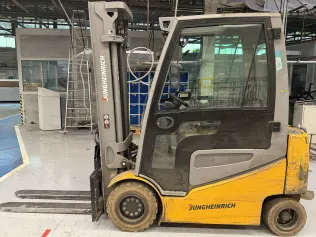
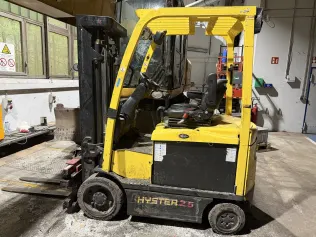
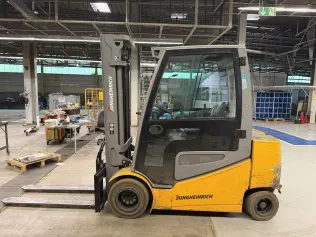
Most major forklift manufacturers include a strong electric range in their product lineup. The most established names in electric forklifts include STILL, LINDE, STEINBOCK, CLARK, NISSAN, and JUNGHEINRICH – each offering reliable, energy-efficient models suited to a wide range of industrial applications. JUNGHEINRICH is also well regarded for its battery-operated pallet trucks.
For demanding lifting requirements, heavy-duty forklifts with capacities of up to 10 tonnes are available from manufacturers such as KOLMAR.