
 This item is sold
1. Storage Containers: Industrial Uses & Types Explained
- Suitable for temporary storage and the transportation of semi-finished and finished products
- Available in a wide range of designs to match specific operational requirements
- Used across virtually every sector where storage or material handling is required
2. Storage Containers: History, Development & Industrial Use
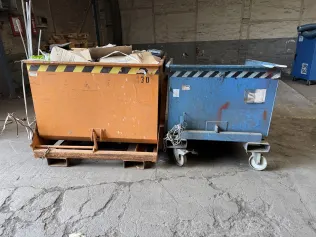
Storage containers are used for the temporary storage and transportation of semi-finished and finished products. As industrialisation has advanced, the primitive wooden and sheet-metal designs of earlier eras have given way to modern, structurally robust variants built from lighter, more durable materials.
Without storage containers, mass production in industrial manufacturing would not be feasible. Today's containers feature machine-readable markings that allow them to be seamlessly integrated into automated production processes.
3. Storage Containers: Industrial Applications and Examples
Storage containers are used across a wide range of industries, including metal processing, machining, and assembly line production, with particularly widespread adoption in logistics. In modern automated facilities, intelligent material flow systems ensure that storage containers are delivered precisely to the required workstations. Early models took the form of small guided vehicles that followed predetermined routes using magnetic loop technology, travelling autonomously to designated machines or workspaces where they were loaded either manually or by industrial robots.
4. Storage Containers: Leading Brands & Manufacturers
Several companies have specialised in the manufacturing of storage containers. Among the most reputable suppliers in this sector are CRAEMER, AUER, ENERPAC, UTZ, ZARGES, HUBER, CHEP INTERNATIONAL, AIRBANK, LOCKWEILER, CEMO and BAGALU.