
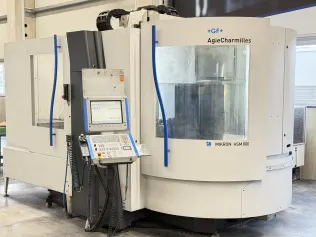
1. Universal Machining Centres: Capabilities & Industry Use
Universal machining centres are versatile industrial workhorses, combining drilling, milling, turning and boring in a single platform. This multi-functional design enables the complex, precise and rapid production of metal components using a range of specialist tools – and many models can be adapted to process other materials such as plastics, ceramics and wood.
Unlike dedicated horizontal or vertical machines, universal machining centres earn their name through a sophisticated architecture that handles a wide variety of operations regardless of component size or orientation. Specialist tools are loaded via pre-programmed sequences, allowing multiple workpieces to be produced simultaneously and keeping cycle times to a minimum.
- Wide scope of machining functions in a single unit
- Simultaneous processing of multiple workpieces
- Moving head with 5-axis capability
2. Universal Machining Centres: History and Development
The rapid development of new technology, combined with growing demand for mass production, drove the creation of universal machining centres. Over time, these machines were continually refined to improve functionality and ease of use. The introduction of computer numerical control (CNC) systems in the mid-20th century marked a turning point, and today the vast majority of machining centres are fully automated. As a result, they have become one of the most widely used machine types across manufacturing, mechanical, and engineering industries.
3. Universal Machining Centres: Applications & Key Features
Universal machining centres are used across a wide range of industries that require the precise processing of metal – including the production of industrial machinery, complex components, moulds, and engineering equipment. They are also widely employed in the manufacture of workpieces for the transport sector.
As highly versatile machines, universal machining centres can accommodate varying numbers of axes depending on the model. The spindle is mounted on a movable head with at least five axes, enabling operations such as milling, water jet cutting, and laser cutting. Movement along each axis can be achieved by adjusting either the worktable or the tool itself. Even machines with the same number of axes may differ in the movements they can perform, so it is worth reviewing specifications carefully. Moving parts are typically enclosed in a protective casing to shield them from swarf and other potential damage.
To produce high-quality workpieces consistently, the joints and axes of a universal machining centre must be exceptionally robust. Regular maintenance, cleaning, and inspection should always be carried out by a qualified technician – never by untrained personnel – given the complexity and cost of the equipment involved. A machine that has been disassembled without proper documentation carries inherent risk, and it is advisable to have any used machine independently assessed before purchase. Since these machines represent a significant investment and are expected to perform reliably over many years, verifying that all joints, axes, and tooling are in excellent working order is essential.
4. Universal Machining Centres: Leading Manufacturers
Leading manufacturers of universal machining centres include GROB, HÜLLER-HILLE, HECKLER & KOCH, HOMA, HERMLE, MIKRON, and LID – each known for precision engineering and reliable performance across a wide range of industrial applications.