
MIKRON HSM 800 Universal Machining Centre






- Storage Number
- 26007-31
- Machine type
- Universal Machining Centres
- Manufacturer
- MIKRON
- Type
- HSM 800
- Year of construction
- 2007
- Location
- Laichingen, Germany
- Price
- Auction item
- Control
- Heidenhain iTNC 530
- Dimensions (LxWxH) approx.
- 3000 x 2500 x 2800 mm
- Dimensions of the clamping surface
- 900 x 600 mm
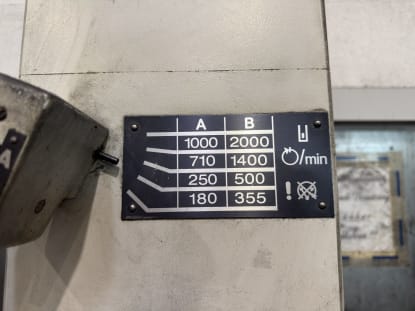
- Spindle speed
- ≥ 24000 rpm
- Travel X-axis
- ≥ 800 mm
- Travel Y-axis
- ≥ 600 mm
- Travel Z-axis
- ≥ 500 mm
- Weight approx.
- 8,300 kg
Mikron HSM 800 – High Speed Machining Center
Year 2007 | Heidenhain iTNC 530 | 24,000 rpm | 3-pallet changer
High-precision CNC machining center from Mikron / GF AgieCharmilles, designed for demanding HSC applications such as mold & die, graphite and electrode machining, as well as flexible production.
Travels: X 800 mm / Y 600 mm / Z 500 mm with pallet size 800 x 600 mm. Equipped with a 3-pallet changer for efficient automated operation.
The machine features a high-speed spindle up to 24,000 rpm with HSK-A63 interface and a 50-position tool magazine.
Well equipped with high-pressure through-spindle coolant (18–70 bar) including band filter system, chip conveyor, minimum quantity lubrication, oil mist extraction, rotating viewing window and probing system (M&H).
Additional features include APS (Advanced Process System) and ITC (Intelligent Thermal Control) for maximum process stability and thermal accuracy.
- Dismantling Costs
- €2,800 - optional
- Transportation costs
- not included
- Terms of delivery
- From foundation
- Terms of payment
- 100% prepayment before pick-up
Transportation costs are not included in the used milling machine price; terms of delivery and payment are stated under "Additional information" in each listing. You should also budget for installation and commissioning at the new site. In most cases, the buyer is responsible for organizing the transport; upon request, ReMach can check whether transport can be arranged or supported. ReMach also helps with dismantling, loading and export paperwork.
Choose the control your operators already know and that is compatible with your existing programs and CAM post-processors. On European machines the most common controls are Heidenhain (TNC, conversational Klartext programming), Siemens SINUMERIK and FANUC. The control version determines the available functions, such as 5-axis cycles, and the availability of spare parts.
The five axes are three linear axes, X, Y and Z, plus two rotary axes, usually two of A, B or C depending on the machine design. In 3+2 machining the rotary axes tilt the part to the required angle before the linear axes cut; in simultaneous 5-axis machining all five move together for complex freeform surfaces. A swivel head suits large, heavy parts, while a swivel-rotary table limits part size and weight to the table.
Choose by the size, weight and shape of your parts. A vertical machining centre suits small and medium parts in series; a portal milling machine handles large, heavy parts such as moulds and machine beds; a bed-type milling machine, with its table on a fixed bed, offers the rigidity for long parts and heavy cutting. A 5-axis machine is for complex parts machined on several sides with few set-ups, while a horizontal boring mill suits large prismatic parts with precise bores on several faces.
A machining centre is a CNC milling machine with a tool magazine and an automatic tool changer. This lets it perform milling, drilling, tapping and boring in one set-up without manual tool changes. The number of magazine positions in the listing shows how many tools a part can use.




Our Services
- Inspection & report
- Disassembly & installation
- Global logistics
- Customs & paperwork
- Sourcing & valuation
- Personal consultation
Related items
1. Universal Machining Centres: Capabilities & Industry Use
Universal machining centres are versatile industrial workhorses, combining drilling, milling, turning and boring in a single platform. This multi-functional design enables the complex, precise and rapid production of metal components using a range of specialist tools – and many models can be adapted to process other materials such as plastics, ceramics and wood.
Unlike dedicated horizontal or vertical machines, universal machining centres earn their name through a sophisticated architecture that handles a wide variety of operations regardless of component size or orientation. Specialist tools are loaded via pre-programmed sequences, allowing multiple workpieces to be produced simultaneously and keeping cycle times to a minimum.
Wide scope of machining functions in a single unit
Simultaneous processing of multiple workpieces
Moving head with 5-axis capability
2. Universal Machining Centres: History and Development
The rapid development of new technology, combined with growing demand for mass production, drove the creation of universal machining centres. Over time, these machines were continually refined to improve functionality and ease of use. The introduction of computer numerical control (CNC) systems in the mid-20th century marked a turning point, and today the vast majority of machining centres are fully automated. As a result, they have become one of the most widely used machine types across manufacturing, mechanical, and engineering industries.
3. Universal Machining Centres: Applications & Key Features
Universal machining centres are used across a wide range of industries that require the precise processing of metal – including the production of industrial machinery, complex components, moulds, and engineering equipment. They are also widely employed in the manufacture of workpieces for the transport sector.
As highly versatile machines, universal machining centres can accommodate varying numbers of axes depending on the model. The spindle is mounted on a movable head with at least five axes, enabling operations such as milling, water jet cutting, and laser cutting. Movement along each axis can be achieved by adjusting either the worktable or the tool itself. Even machines with the same number of axes may differ in the movements they can perform, so it is worth reviewing specifications carefully. Moving parts are typically enclosed in a protective casing to shield them from swarf and other potential damage.
To produce high-quality workpieces consistently, the joints and axes of a universal machining centre must be exceptionally robust. Regular maintenance, cleaning, and inspection should always be carried out by a qualified technician – never by untrained personnel – given the complexity and cost of the equipment involved. A machine that has been disassembled without proper documentation carries inherent risk, and it is advisable to have any used machine independently assessed before purchase. Since these machines represent a significant investment and are expected to perform reliably over many years, verifying that all joints, axes, and tooling are in excellent working order is essential.
4. Universal Machining Centres: Leading Manufacturers
Leading manufacturers of universal machining centres include GROB, HÜLLER-HILLE, HECKLER & KOCH, HOMA, HERMLE, MIKRON, and LID – each known for precision engineering and reliable performance across a wide range of industrial applications.