
1. What Are Welding Machines Used For?
Welding machines are used to permanently bond workpieces together. They are primarily used for metal fabrication, though they are also widely applied in plastic welding. It is worth distinguishing between welding machines and welding equipment more broadly – welders, for instance, are self-contained components that can operate independently and be moved between locations. Most traditional welding machines, by contrast, are stationary units designed for mass production and fixed at a specific point on a production line. The appropriate type and configuration of a welding machine is typically determined by the thickness and material of the workpieces being processed.
2. How Does a Welding Machine Work?
A welding machine joins two surfaces through a thermal melting process. Heat is applied either at a specific point or along a seam, and the surfaces are pressed together under high pressure before cooling and solidifying into a permanent, robust bond. This connection can only be broken by destroying the workpiece itself. Welding is also used for build-up applications and filling holes, tasks typically carried out with hand-held welding equipment rather than a full welding machine.
- Creates permanent bonds between workpieces
- Primarily used for metal processing
- Machine type is generally determined by the thickness of the material
3. Types of Welding Machines: A Complete Guide
Welding machines come in a wide variety of types and configurations, each suited to specific applications and requiring different levels of operator skill. The most commonly used types of welding machines are:
- Spot welding machine
- Arc welding machine
- MIG welding machine
- Gas welding machine
- TIG welding machine
- Submerged arc welding machine
- Inverter welding machine
- AC/DC welding machine
4. Welding Machinery: Processes, Types & Applications
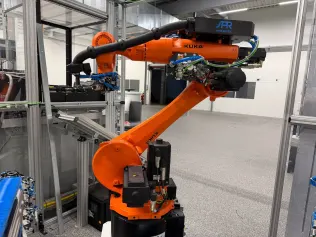
Welding machinery is used across a wide range of joining processes, from simple spot welding to complex submerged arc techniques. Spot welding – one of the most straightforward methods – uses a dedicated machine to fix pre-formed components together using localised melt-flows. This process, along with arc welding, is widely used in the mass production of thin-walled metal products. For larger or more complex workpieces such as automobile bodies, a spot welding gun is the preferred tool. When integrated with industrial robots, spot welding equipment enables highly efficient, fully automated metal bonding.
Arc Welding Machinery
Arc welding joins metals using electrical energy, generating sufficient heat to melt and fuse the base materials. An arc welding machine creates an electric arc between the electrode and the base material, melting both at the welding point and forming a strong bond once cooled.
Submerged arc welding is a specialised variant designed for thick-walled workpieces such as large tubes and pipes. Rather than using a shielding gas, the process applies an iron oxide powder directly to the weld zone. This is a technically demanding method that requires skilled, experienced operators and is typically subject to rigorous quality control – including regular checks of the fatigue strength of the finished weld seam at each stage of the process.
Other arc welding variants include inverter welding machines and AC/DC welding machines. Inverter-based equipment offers notable advantages over conventional designs, including a more compact form factor and reduced energy consumption. AC/DC welding machines, meanwhile, can operate with both alternating and direct current – offering greater flexibility than standard AC-only welders.
Gas and Gas-Shielded Welding
Gas welding machines use an oxy-acetylene flame to bring the base material to melting point while simultaneously feeding in a filler rod. This technique is particularly effective for build-up welding – filling openings, surface irregularities, or gaps – and is well suited to welding cast iron.
Gas-shielded welding is one of the most widely used processes alongside arc welding. A continuous flow of shielding gas prevents oxygen from reaching the weld zone, which would otherwise cause burn-through. These machines are available in both hand-held and fully automatic configurations. Within gas-shielded welding, operators can choose between metal inert gas (MIG), metal active gas (MAG), or tungsten inert gas (TIG) welding, depending on the material and application.
5. Quality Used Welding Machines: Brands & Pricing Guide
Finding a quality second-hand welding machine requires knowing which brands and price points to look for. Leading welding machine manufacturers include MESSER, ROTH, WALTER, and KIEHNE, all known for their reliability and precision engineering. While simpler used welding machines are available from a few hundred euros, more complex and industrial-grade equipment can exceed ten thousand euros. The second-hand market regularly offers high-quality machines at competitive prices, making it a practical option for businesses and workshops seeking cost-effective solutions.