
DMG MORI DMU 200P 5-axis CNC machining center


- Storage Number
- 26018-532
- Machine type
- 5-Axis Machining Centres
- Manufacturer
- DMG MORI
- Type
- DMU 200 P
- Year of construction
- 2006
- Location
- Zwickau, Germany
- Availability
- immediately
- Price
- This item is sold
- Dimensions (LxWxH) approx.
- 7500 x 6000 x 5000 mm
- Travel X-axis
- ≥ 2000 mm
- Travel Y-axis
- ≥ 1800 mm
- Travel Z-axis
- ≥ 1170 mm
- Weight approx.
- 45,000 kg
Machine No.: 10990003463
Control System
Heidenhain iTNC 530 (3D path control)
Travel Paths
X: 1,850 mm
Y: 2,000 mm
Z: 1,100 mm
B-axis: controlled universal swivel milling head
C-axis: NC rotary table Ø 1,700 mm
5-axis simultaneous machining
Spindle
Motor spindle SK50
Speed: 25–12,000 rpm
Power: 44 kW (40% duty cycle) / 32 kW (100% duty cycle)
Torque: 288 / 187 Nm
Tool holder: SK50 according to DIN 69871
Tool Changer
60-slot tool magazine
Double gripper
Equipment
IKZ 40 bar
Chip conveyor
Tool measurement system Blum Laser NT Hybrid
Heidenhain TS 640 infrared probe
Electronic handwheel
Minimum quantity lubrication (MQL)
Oil/emulsion mist separator
Coolant through spindle
Coolant tank 980 l
ATC (Application Tuning Cycle)
Laminated safety glass window
Operating mode 4 (process observation)
- Dismantling Costs
- €20,000 - optional
- Transportation costs
- not included
- Terms of delivery
- EXW EX Works
- Terms of payment
- 100% prepayment before pick-up
Transportation costs are not included in the used milling machine price; terms of delivery and payment are stated under "Additional information" in each listing. You should also budget for installation and commissioning at the new site. In most cases, the buyer is responsible for organizing the transport; upon request, ReMach can check whether transport can be arranged or supported. ReMach also helps with dismantling, loading and export paperwork.
Choose the control your operators already know and that is compatible with your existing programs and CAM post-processors. On European machines the most common controls are Heidenhain (TNC, conversational Klartext programming), Siemens SINUMERIK and FANUC. The control version determines the available functions, such as 5-axis cycles, and the availability of spare parts.
The five axes are three linear axes, X, Y and Z, plus two rotary axes, usually two of A, B or C depending on the machine design. In 3+2 machining the rotary axes tilt the part to the required angle before the linear axes cut; in simultaneous 5-axis machining all five move together for complex freeform surfaces. A swivel head suits large, heavy parts, while a swivel-rotary table limits part size and weight to the table.
Choose by the size, weight and shape of your parts. A vertical machining centre suits small and medium parts in series; a portal milling machine handles large, heavy parts such as moulds and machine beds; a bed-type milling machine, with its table on a fixed bed, offers the rigidity for long parts and heavy cutting. A 5-axis machine is for complex parts machined on several sides with few set-ups, while a horizontal boring mill suits large prismatic parts with precise bores on several faces.
A machining centre is a CNC milling machine with a tool magazine and an automatic tool changer. This lets it perform milling, drilling, tapping and boring in one set-up without manual tool changes. The number of magazine positions in the listing shows how many tools a part can use.
This item is sold


Our Services
- Inspection & report
- Disassembly & installation
- Global logistics
- Customs & paperwork
- Sourcing & valuation
- Personal consultation
Related items
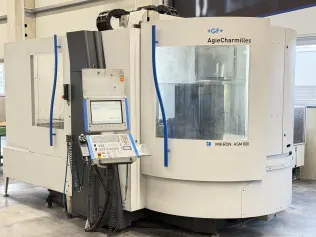
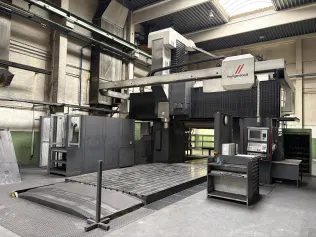
1. Used 5-Axis Machining Centres
A 5-axis machining centre has the three linear axes X, Y and Z plus two rotary axes, so the tool can reach the workpiece from almost any direction. Several faces are machined in one set-up, which reduces the number of set-ups and keeps the positional accuracy between those faces. Typical parts:
Moulds and cores with free-form surfaces
Aerospace components and turbine blades
Prismatic parts machined on several faces in one set-up
Complex one-off parts and small series
ReMach lists second hand 5-axis machining centres, with travels, control, tool magazine and photos on every machine page.
>>> Browse the machines below or send an enquiry for the configuration you need.
2. 3+2 Positional and Simultaneous 5-Axis Machining
Both run on a 5-axis machine, but they work differently. Knowing which one your parts need avoids paying for capability you will not use, or buying a machine that cannot do the job.
3+2 Positional Machining
The two rotary axes tilt the part or the head to the required angle and are then clamped
The three linear axes do the cutting
Enough for most prismatic parts that need machining on several faces
Lower CAM requirements and simpler programming
Simultaneous 5-Axis Machining
All five axes move at the same time along the whole tool path
Needed for free-form surfaces, turbine blades and continuous curved tool paths
Requires 5-axis CAM and a post-processor matched to that exact machine and control
In listings this is usually stated as "5-axis simultaneous machining"
A machine that supports simultaneous 5-axis machining can also run 3+2, but not every 3+2 machine can run simultaneously. When reading a listing, look for the word "simultaneous" and for the control model.
3. Rotary Axis Design: Swivel Head, Trunnion Table or Gantry
Where the two rotary axes sit determines the maximum part size and weight. This is the biggest difference between 5-axis machines.
Swivel Head with Rotary Table (B-axis in the head, C-axis in the table)
The B-axis sits in the milling head, the C-axis is an NC rotary table
Heavy parts stay flat on the table, only the head tilts
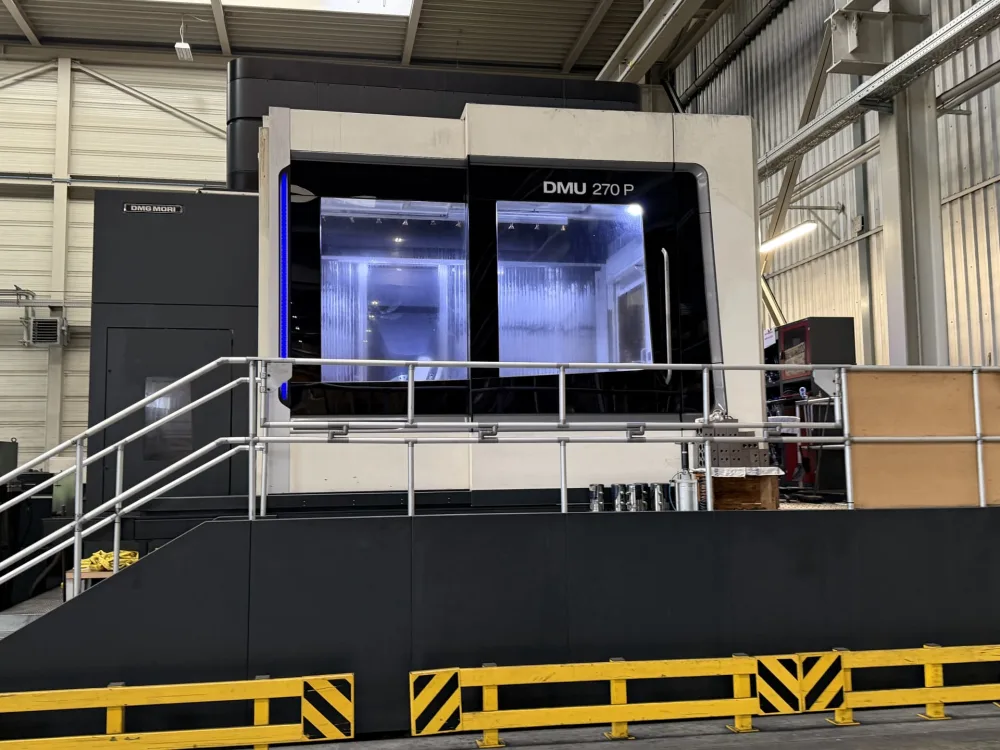
Suited to large, heavy parts; this is the design of the DMG MORI DMU P series
Trunnion Table
Both rotary axes are in the table, so the part tilts with it
Compact and accurate for small and medium parts
Part size and weight are limited by the table
Gantry (Portal) Design
The spindle moves on a gantry above a fixed table
Suited to very long or wide parts such as plates and large moulds
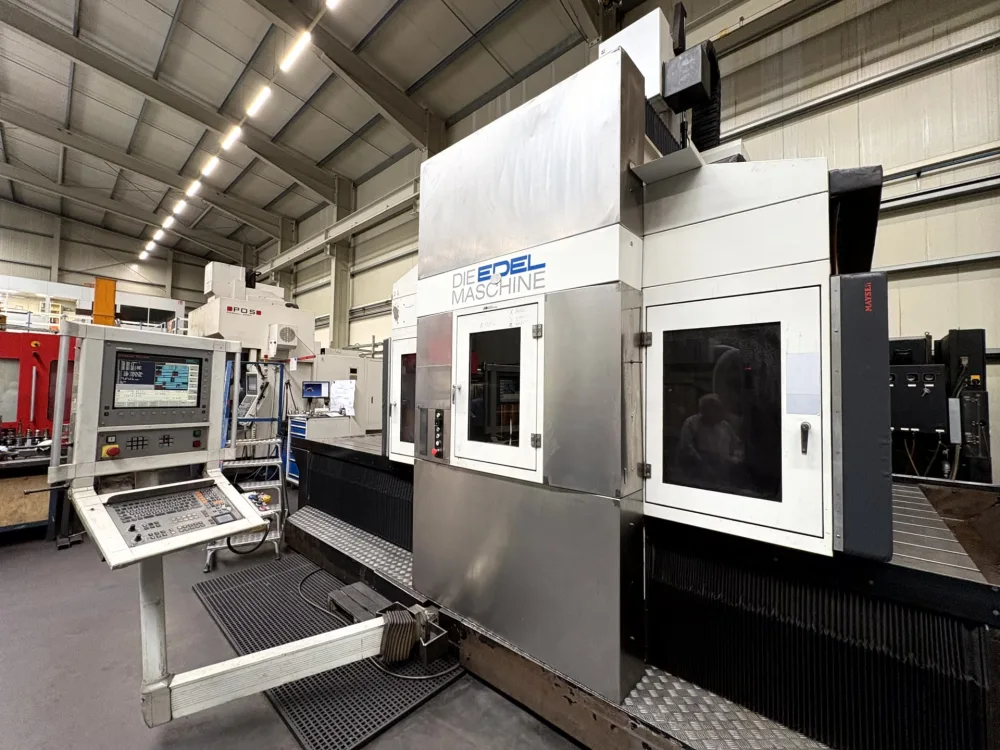
Example: EDEL CP3020, table 5,000 x 2,300 mm, A-axis ±110°, C-axis ±360°
5-axis machining centres documented in the ReMach catalogue include the DMG MORI DMU P series, Reiden and EDEL. X-axis travels range from 980 mm to 3,000 mm and machine weights from approx. 16 t to 85 t.
4. What to Check on a Used 5-Axis Machining Centre
Besides travels and spindle power, which matter on any milling machine, a 5-axis machine has a few points of its own.
Working Envelope
Travels and table size: X, Y and Z travel together with the table dimensions
Rotary table: diameter and maximum table load
Swivel range: for example A-axis ±110°, B- or C-axis ±360°; it decides which tool angles you can reach
Rotary Axes and Accuracy
NC control of both rotary axes: fully NC controlled, or only manually indexed
In-machine measurement: tool and workpiece probing, for example a touch probe or laser system
Kinematic calibration: after relocation, the rotary axis kinematics must be recalibrated before precision parts are run
Control and Operation
Control and version: for example Heidenhain iTNC 530 with 3D path control
Tool magazine and taper: number of tool positions and taper, for example SK50 to DIN 69871, or HSK
CAM post-processor: it must match the machine and control, otherwise simultaneous 5-axis machining cannot be used
Spindle hours: where the listing states them
5. Installation, Transport and FAQ
5-axis machining centres weigh roughly 16 t to 85 t depending on size. Plan the following before buying:
Foundation and hall: large machines need a foundation to the manufacturer's drawing; check the machine dimensions in the listing against floor space, hall height and crane capacity
Dismantling and transport: in most cases the buyer is responsible for organizing the transport; upon request, ReMach can check whether transport can be arranged or supported
Paperwork: ReMach helps with dismantling and loading, export and customs checks, and export documents
See all machining centres in our CNC Machining Centres category, or other machine types under Milling Machines.
Do I need simultaneous 5-axis machining, or is 3+2 enough?
If your parts are mainly flat faces and holes on several sides, 3+2 is enough and programming is simpler. Simultaneous 5-axis machining is needed for free-form surfaces such as moulds and turbine blades, where the tool must tilt continuously along the path.
Which design should I choose: swivel head, trunnion table or gantry?
A swivel head with a rotary table suits large, heavy parts because the part does not tilt. A trunnion table is compact and accurate for small and medium parts. A gantry machine suits very long or wide parts.
Does a used 5-axis machine need recalibration after relocation?
Yes. After dismantling, transport and reinstallation, the rotary axis kinematics should be recalibrated and checked with a test part before precision work starts.
Can I keep my existing CAM programs?
Not automatically. 5-axis programming needs a CAM post-processor matched to the machine design and the control, so confirm the control and its version before buying.
How heavy is a used 5-axis machining centre and how is it transported?
In the ReMach catalogue, 5-axis machines weigh from approx. 16 t to 85 t. The machine is dismantled into assemblies and moved by heavy haulage. In most cases the buyer is responsible for organizing the transport; upon request, ReMach can check whether transport can be arranged or supported.
>>> Send an enquiry about a 5-axis machining centre