
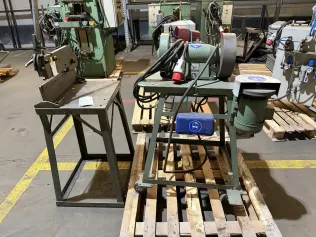
1. Fladder Machines: Smooth Surfaces & Clean Edges
A fladder is a specialist finishing machine designed for sanding and smoothing wood workpieces, as well as deburring, brushing, and polishing metal components. Originally developed in Denmark for the furniture industry, fladder technology has become a trusted solution for efficient, high-quality surface processing across a range of manufacturing applications.
Key capabilities of fladder machines include surface treatment for both wood and metal workpieces, delivering an automatic and consistent approach to sanding and finishing that saves time while maintaining precision results.
2. Fladder Machines: From Furniture to Metalworking
The fladder was invented in the 1970s by the Danish development centre Hansen & Hundebøl to meet the needs of leading furniture manufacturers seeking an efficient, automated sanding solution. The machine uses rotating rollers closely resembling the brushes found in a car wash. Originally designed exclusively for wooden workpieces, the fladder has since expanded into metal surface processing as well. Fladder Danmark A/S was subsequently established under the Hansen & Hundebøl Group to handle the manufacture and maintenance of these machines.
3. Fladder Machines: Achieving High-Quality Surfaces Efficiently
Fladder machines deliver consistently high-quality surfaces when processing both wood and metal workpieces. Available as handheld tools or stationary units, these machines can be fully automated and integrated into existing manufacturing systems. Stationary models typically feature automatic workpiece feeds via rotating or linear work tables, and can be equipped with counter-rotating roller pairs or a roller star – the latter supporting both rotating and oscillating movements to suit a wide range of workpiece geometries.
In woodworking, the key advantage of a fladder over conventional sanding machines is its ability to produce smoother, more even surfaces while removing fewer wood fibres. This reduces the need for additional finishing steps after painting, and minimises the use of filler or varnish. The process also creates gently rounded corners that bond more effectively with veneer coatings and are less susceptible to damage than those produced by standard sanding.
In metalworking, fladder machines enable precise, efficient deburring without compromising the workpiece surface. Even coated materials – such as galvanised sheet metal or stainless steel with a protective film – can be processed to achieve clean, rounded edges while leaving the coating intact.
4. Fladder Machines: Who Makes Them?
Fladder machines are manufactured by the Danish company FLADDER, a specialist producer that builds these systems to order due to the relatively recent development of the technology.