
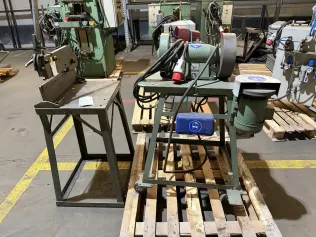
1. Sanding, Polishing & Lapping Machines Explained
Today's CNC mills and lathes already achieve outstanding dimensional accuracy and precision. Yet the most highly refined workpieces – tolerances down to a ten-thousandth of a millimetre – are no longer produced by cutting alone. Modern manufacturing relies on specialist finishing machines that work through abrasion rather than chisels or blades. This is where sanding, polishing, and lapping machines come into their own, with a broad range of solutions developed for both metalworking and woodworking applications.
2. Wood Sanding & Polishing Machines: Complete Guide
In the woodworking industry, sanding and polishing machines serve much the same purpose as grinding machines do in metalworking – ensuring dimensional accuracy, achieving precise surface finishes, and preparing wooden materials for coatings. A wide range of specialised equipment has been developed to handle the unique demands of wood as a material, each designed for specific applications.
Common types of wood sanding and polishing machines include wide belt sanders, fladder sanders, veneer sanders, edge sanding machines, long belt sanders, strip sanding machines, profile sanders, frame sanding machines, rod sanding machines, and cylinder sanding machines.
Belt and Wide Belt Sanding Machines
Belt and wide belt sanding machines are designed to level surfaces using a continuous sanding belt tensioned between two rollers – a drive roller and a tensioning roller. The drive roller is connected to an electric motor via a gear mechanism, and the tensioning roller maintains the belt under sufficient load to prevent slipping. Once running, the belt moves in a continuous loop, ready to receive the workpiece.
The key advantage of belt sanding machines is their broad sanding surface, making them well suited to levelling uneven timber. They are equally effective at removing old coatings or veneers from otherwise even surfaces. Table-top belt sanders are produced by manufacturers such as FALKEN, UVM and BINI, while wide belt wood sanders are available from LISSMAC, CASADEI, TAGLIABUE and HEESEMANN.
Fladder Sanders
While belt sanders perform well for many tasks, their sanding belts wear relatively quickly and require frequent replacement. Fladder machines offer a more productive alternative, using rotating rollers fitted with abrasive strip attachments rather than a conventional belt. This construction is considerably more durable, making fladder machines suitable for demanding tasks such as deburring metal components and pre-sanding rough-sawn timber surfaces. Leading manufacturers include FLADDER and SORBINI.
Veneer Sanding Machines
After the peeling and steaming process, veneer sheets are typically uneven and require further treatment before use. Depending on the production process, veneer may be sanded before or after bonding to the substrate. A wide selection of industrial sanders exists specifically for veneer processing, using sanding rollers, sanding belts, or eccentric mechanisms to achieve the required surface quality.
Edge Sanding Machines
Applying and finishing veneers on edges is among the most demanding operations in woodworking, and the machinery involved is correspondingly sophisticated. Edge processing lines are frequently equipped with soft-forming and post-forming units alongside integrated sanding stations, which sand and polish the edge to a high standard. Both belt and eccentric sanders are commonly used in these configurations, though stand-alone edge sanding machines are also available. Recognised manufacturers in this segment include ARMINIUS, REHNEN, HAPFO BSM, BOERE and LOEWER.
Long Belt Sanders
Long belt sanders are particularly efficient for processing edges and surfaces of extended or wide profiles. The sanding belt is arranged in a floating configuration above the work table, and the workpiece is guided beneath it on a sliding carriage. The greater the belt length, the longer or wider the board or profile that can be machined in a single pass. Notable manufacturers include JOHANNSEN, SAMCO, HEESEMANN, HÖFER and COMAS.
Strip Sanding Machines and Profile Sanders
Strip sanding machines – also known as brush sanders – are designed to finish and smooth long wooden components across a wide variety of contour shapes. They use brush rollers as standard and, despite their technical simplicity, deliver consistent results across complex profiles. An integrated conveyor unit feeds the workpiece automatically beneath the sanding roller, controlling the rate of material removal and ensuring an even finish. Well-known manufacturers include LOEWER, VEMJAKOB, RECKMANN, STEMAS and STAEHLE.
Frame Sanding Machines
Frame sanding machines are distinguished by their two tensioning rollers, which create a triangular belt path rather than the single-roller arrangement found on standard belt sanders. This configuration allows the sanding belt to press vertically against frames as they pass through, producing a consistently uniform finish across a wide range of sanding surfaces. This makes them particularly well suited to window frame manufacturing, where surface quality standards are high. Common manufacturers include SAMCO, MAWEG, MEBLO, ELU and DEWALT.
Rod Sanding Machines
Wooden rods serve both structural and decorative functions in woodworking, and when used in tenon joints they must meet strict dimensional tolerances. Rod sanding machines are designed specifically for this purpose. They typically feature one or two vertically arranged belt sanding stations, with press rollers rotating in the opposite direction to the belt. This counter-rotation holds the rod firmly in position while ensuring consistent machining along its full length and circumference. Established manufacturers include EHEMANN, SCHUMAG, LOCATELLI, HEMPEL, CAMAM and WINTER.
Cylinder Sanding Machines
Cylinder sanding machines combine the principles of roller and belt sanding through the use of a sanding cylinder – a dimensionally defined cylinder to which a sanding belt is bonded. This design is technically less complex than a conventional belt sander and more precise than a fladder machine. A notable practical advantage is that the cylinder can be manufactured to virtually any required width, making it highly reliable for processing large boards where standard sanding belts might be prone to tearing under load. Leading manufacturers include DANKERT, HOLZMANN, JET and ZIMMERMANN.
3. Buying a Wood Sander: What You Need to Know
Machine Frame
Wood sanding machines are technically straightforward, and when built to industrial standards, this simplicity works in their favour. The machine table, frame, and guidance mechanisms are typically highly robust and designed for long-term, heavy-duty use with minimal wear on core structural components.
Wear Parts
While the frame is durable, certain components do require regular attention. Bearings in particular need frequent replacement due to the demands of continuous operation. Motors and switches are also subject to wear over time and are not designed to last indefinitely without servicing. Using effective dust extraction can significantly extend the lifespan of electrical components, as fine wood dust that accumulates inside the machine can cause short-circuits and blockages.
Maintenance
Used wood sanders generally offer low maintenance costs and minimal downtime, making them a practical choice for workshops on a budget. In most cases, thorough cleaning combined with targeted replacement of critical components is enough to bring an older machine back to fully operational condition.